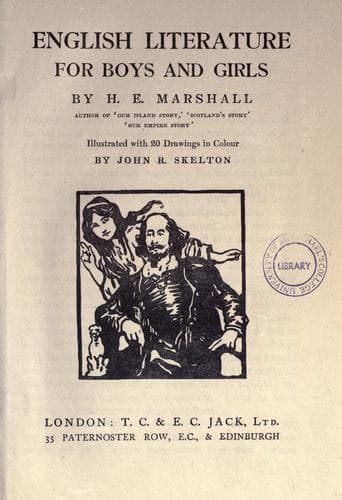
English Literature for Boys and GirlsMarshall, H. E. (Henrietta Elizabeth)
History
English Literature for Boys and Girls
Marshall, H. E. (Henrietta Elizabeth)
English literature -- History and criticism
Bunyan was born when the struggle between King and people was
beginning to be felt, and was a great boy of fourteen when at
last the armies of King and Parliament met on the battlefield of
Edgehill. To many this struggle was a struggle for freedom in
religion. From end to end of our island the question of religion
was the burning question of the day. Religion had wrought itself
into the lives of people. In those days of few books the Bible
was the one book which might be found in almost every house. The
people carried it in their hands, and its words were ever on
their lips. But the religion which came to be the religion of
more than half the people of England was a stern one. They
forgot the Testament of Love, they remembered only the Testament
of Wrath. They made the narrow way narrower, and they believed
that any who strayed from it would be punished terribly and
eternally. It was into this stern world that little John Bunyan
was born, and just as a stern religious struggle was going on in
England so a stern religious struggle went on within his little
heart. He heard people round him talk of sins and death, of a
dreadful day of judgment, of wrath to come. These things laid
hold of his childish mind and he began to believe that in the
sight of God he must be a desperate sinner. Dreadful dreams came
to him at night. He dreamed that the Evil One was trying to
carry him off to a darksome place there to be "bound down with
the chains and bonds of darkness, unto the judgment of the great
day." Such dreams made night terrible to him.
Bunyan tells us that he swore and told lies and that he was the
ringleader in all the wickedness of the village. But perhaps he
was not so bad as he would have us believe, for he was always
very severe in his judgments of himself. Perhaps he was not
worse than many other boys who did not feel that they had sinned
beyond all forgiveness. And in spite of his awful thoughts and
terrifying dreams Bunyan still went on being a naughty boy; he
still told lies and swore.
At length he left school and became a tinker like his father.
But all England was being drawn into war, and so Bunyan, when
about seventeen, became a soldier.
Strange to say we do not know upon which side he fought. Some
people think that because his father belonged to the Church of
England that he must have fought on the King's side. But that is
nothing to go by, for many people belonged to that Church for old
custom's sake who had no opinions one way or another, and who
took no side until forced by the war to do so. It seems much
more likely that Bunyan, so Puritan in all his ways of thought,
should fight for the Puritan side. But we do not know. He was
not long a soldier, we do not know quite how long, it was perhaps
only a few months. But during these few months his life was
saved by, what seemed to him afterwards to have been a miracle.
Public-domain text, read in full here on John Shaqi.
Reviews
Reviews
No reviews yet
Be the first to share your thoughts on this work.
Elsewhere in the archive