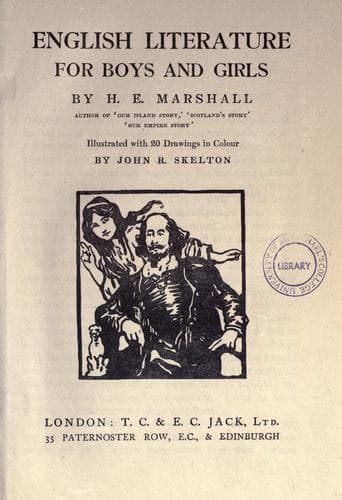
English Literature for Boys and GirlsMarshall, H. E. (Henrietta Elizabeth)
History
English Literature for Boys and Girls
Marshall, H. E. (Henrietta Elizabeth)
English literature -- History and criticism
"When I was a soldier," he says, "I, with others, were drawn out
to go to such a place to besiege it. But when I was just ready
to go one of the company desired to go in my room. To which,
when I had consented, he took my place. And coming to the siege,
as he stood sentinel, he was shot in the head with a musket
bullet, and died.
"Here, as I said, were judgments and mercy, but neither of them
did awaken my soul to righteousness. Wherefore I sinned still,
and grew more and more rebellious against God."
So whether Bunyan served in the Royal army, where he might have
heard oaths, or in the Parliamentarian, where he might have heard
godly songs and prayers, he still went on his way as before.
Some time after Bunyan left the army, and while he was still very
young, he married. Both he and his wife were, he says, "as poor
as poor might be, not having so much household stuff as a dish or
a spoon betwixt us both. Yet this she had for her part, The
Plain Man's Pathway to Heaven and The Practice of Piety, which
her father had left her when he died."
These two books Bunyan read with his wife, picking up again the
art of reading, which he had been taught at school, and which he
had since almost forgotten. He began now to go a great deal to
church, and one of his chief pleasures was helping to ring the
bells. To him the services were a joy. He loved the singing,
the altar with its candles, the rich robes, the white surplices,
and everything that made the service beautiful. Yet the terrible
struggle between good and evil in his soul went on. He seemed to
hear voices in the air, good voices and bad voices, voices that
accused him, voices that tempted. He was a most miserable man,
and seemed to himself to be one of the most wicked, and yet
perhaps the worst thing he could accuse himself of doing was
playing games on Sunday, and pleasing himself by bell-ringing.
He gave up his bell-ringing because it was a temptation to
vanity. "Yet my mind hankered, therefore I would go to the
steeple house and look on, though I durst not ring." One by one
he gave up all the things he loved, things that even if we think
them wrong do not seem to us to merit everlasting punishment.
But at last the long struggle ended and his tortured mind found
rest in the love of Christ.
Public-domain text, read in full here on John Shaqi.
Reviews
Reviews
No reviews yet
Be the first to share your thoughts on this work.
Elsewhere in the archive
Join the Discussion
Join the discussion
Sign in to leave a comment or review.
Sign InorCreate an account