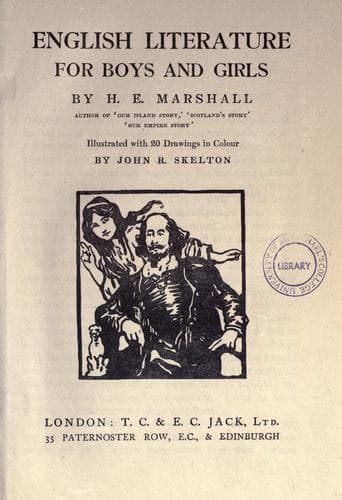
English Literature for Boys and GirlsMarshall, H. E. (Henrietta Elizabeth)
History
English Literature for Boys and Girls
Marshall, H. E. (Henrietta Elizabeth)
English literature -- History and criticism
The Fables was the last book Dryden wrote. He was growing to be
an old man, and a few months after it was published he became
very ill. "John Dryden, Esq., the famous poet, lies a-dying,"
said the newspapers on the 30th April, 1700. One May morning he
closed his eyes for ever, just as
"Aurora had but newly chased the night,
And purpled o'er the sky with blushing light."
Chapter LXI DEFOE--THE FIRST NEWSPAPERS
TO almost every house in the land, as regular as the milk man,
more regular than the postman, there comes each morning the
newspaper boy. To most of us breakfast means, as well as things
to eat, mother pouring out the tea and father reading the
newspaper. As mother passes father's tea she says, "Anything in
the paper, John?" And how often he answers, "Nothing, nothing
whatever."
Although father says there is nothing in the paper there is a
great deal of reading in it, that we can see. And now comes the
question, Who writes it all? Who writes this thin, flat book of
six or eight great pages which every morning we buy for a penny
or a halfpenny? But perhaps you think it does not matter who
writes the newspapers, for the newspaper is not literature.
Literature means real books with covers--dear possessions to be
loved and taken care of, to be read and read again. But a
newspaper is hardly read at all when it is crumpled up and used
to light the fire. And no one minds, for who could love a
newspaper, who cares to treasure it, and read it again and yet
again?
We do not want even to read yesterday's newspapers, for
newspapers seem to hold for us only the interest of the day. The
very name by which they used to be called, journal, seems to tell
us that, for it comes from the French word "jour," meaning "a
day." Newspapers give us the news of the day for the day. Yet
in them we find the history of our own times, and we are
constantly kept in mind of how important they are in our everyday
life by such phrases as "the freedom of the Press," "the opinion
of the Press," the Press meaning all the newspapers, journals and
magazines and the people who write for them.
So we come back again to our question, Who writes for the
newspapers? The answer is, the journalists. A newspaper is not
all the work of one man, but of many whose names we seldom know,
but who work together so that each morning we may have our paper.
And in this chapter I want to tell you about one of our first
real journalists, Daniel Defoe. Of course you know of him
already, for he wrote Robinson Crusoe, and he is perhaps your
favorite author. But before he was an author he was a
journalist, and as I say one of our first.
For there was a time when there were no newspapers, nothing for
father to read at breakfast-time, and no old newspapers to
crumple up and light fires with. The first real printed English
newspaper was called the Weekly News. It was published in 1622,
while King Charles I was still upon the throne.
Public-domain text, read in full here on John Shaqi.
Reviews
Reviews
No reviews yet
Be the first to share your thoughts on this work.
Elsewhere in the archive
Join the Discussion
Join the discussion
Sign in to leave a comment or review.
Sign InorCreate an account