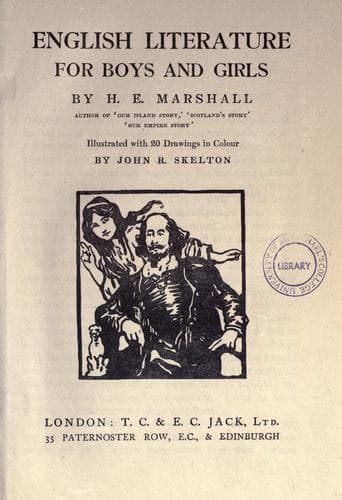
English Literature for Boys and GirlsMarshall, H. E. (Henrietta Elizabeth)
History
English Literature for Boys and Girls
Marshall, H. E. (Henrietta Elizabeth)
English literature -- History and criticism
But this first paper and others that came after it were very
small. The whole paper was not so large as a page of one of our
present halfpenny papers. The news was told baldly without any
remarks upon it, and when there was not enough news it was the
fashion to fill up the space with chapters from the Bible.
Sometimes, too, a space was left blank on purpose, so that those
who bought the paper in town might write in their own little bit
of news before sending it off to country friends.
Defoe was one of the first to change this, to write articles and
comments upon the news. Gradually newspapers became plentiful.
And when Government by party became the settled form of our
Government, each party had its own newspaper and used it to help
on its own side and abuse the other.
Milton and Dryden were really journalists; Milton when he wrote
his political pamphlets, and Dryden when he wrote Absalom and
Achitophel and other poems of that kind. But they were poets
first, journalists by accident. Defoe was a journalist first,
though by nature ever a story-teller.
Daniel Defoe, born in 1661, was the son of a London butcher names
James Foe. Why Daniel, who prided himself on being a true-born
Englishman, Frenchified his name by adding a "De" to it we do not
know, and he was over forty before he changed plain Foe into
Defoe.
Daniel's father and mother were Puritans, and he was sent to
school with the idea that he should become a Nonconformist
minister. But Defoe did not become a minister; perhaps he felt
he was unsuited for such solemn duty. "The pulpit," he says
later, "is none of my office. It was my disaster first to be set
apart for, and then to be set apart from the honor of that sacred
employ."
Defoe never went to college, and because of this many a time in
later days his enemies taunted him with being ignorant and
unlearned. He felt these taunts bitterly, and again and again
answered them in his writings. "I have been in my time pretty
well master of five languages," he says in one place. "I have
also, illiterate though I am, made a little progress in science.
I have read Euclid's Elements. . . . I have read logic. . . . I
went some length in physics. . . . I thought myself master of
geography and to possess sufficient skill in astronomy." Yet he
says I am "no scholar."
When Defoe left school he went into the office of a merchant
hosier. It was while he was in this office that King Charles II
died and King James II came to the throne. Almost at once there
followed the Duke of Monmouth's rebellion. The Duke was a
Protestant and James was a Catholic. There were many in the land
who feared a Catholic King, and who believed too that the Duke
had more right to the throne than James, so they joined the
rebellion. Among them was Daniel. But the Rebellion came to
nothing. In a few weeks the Duke's army was scattered in flight,
and he himself a wretched prisoner in the Tower.
Public-domain text, read in full here on John Shaqi.
Reviews
Reviews
No reviews yet
Be the first to share your thoughts on this work.
Elsewhere in the archive
Join the Discussion
Join the discussion
Sign in to leave a comment or review.
Sign InorCreate an account