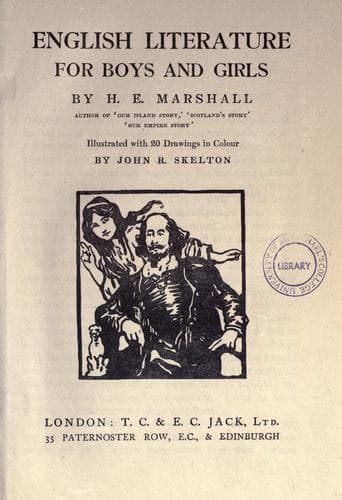
English Literature for Boys and GirlsMarshall, H. E. (Henrietta Elizabeth)
History
English Literature for Boys and Girls
Marshall, H. E. (Henrietta Elizabeth)
English literature -- History and criticism
Happier than many of his comrades, Defoe succeeded in escaping
death or even punishment. Secretly and safely he returned to
London and there quietly again took up his trade of merchant
hosier. But he did not lose his interest in the affairs of his
country. And when the glorious Revolution came he was one of
those who rode out to meet and welcome William the Deliverer.
But perhaps he allowed politics to take up too much of his time
and thought, for although he was a good business man he failed
and had to hide from those to whom he owed money. But soon we
find him setting to work again to mend his fortunes. He became
first secretary to and then part owner of a tile and brick
factory, and in a few years made enough money to pay off all his
old debts.
By this time Defoe had begun to write, and was already known as a
clever author. Now some one wrote a book accusing William among
many other "crimes" of being a foreigner. Defoe says, "this
filled me with a kind of rage"; and he replied with a poem called
The True-born Englishman. It became popular at once, thousands
of copies being sold in the first few months. Every one read it
from the King in his palace to the workman in his hut, and long
afterwards Defoe was content to sign his books "By the author of
'The True-born Englishman.'" It made Defoe known to the King.
"This poem," he said, "was the occasion of my being known to his
Majesty." He was received and employed by him and "above the
capacity of my deserving, rewarded." He was given a small
appointment in the Civil Service. All his life after Defoe loved
King William and was his staunch friend, using all the power of
his clever pen to make the unloved Dutch King better understood
of his people. But when King William died and Queen Anne ruled
in his stead Defoe fell on evil times.
In those days the quarrels about religion were not yet over.
There was a party in the Church which would very willingly have
seen the Nonconformists or Dissenters persecuted. Dissenters
were like to have an evil time. To show how wrong persecution
was, Defoe wrote a little pamphlet which he called The Shortest
Way with the Dissenters. He wrote as if he were very angry
indeed with the Dissenters. He said they had been far too kindly
treated and that if he had his way he would make a law that
"whoever was found at a conventicle should be banished the nation
and the preacher be hanged. We should soon see an end of the
tale--they would all come to Church, and one age would make us
all one again."
Public-domain text, read in full here on John Shaqi.
Reviews
Reviews
No reviews yet
Be the first to share your thoughts on this work.
Elsewhere in the archive
Join the Discussion
Join the discussion
Sign in to leave a comment or review.
Sign InorCreate an account