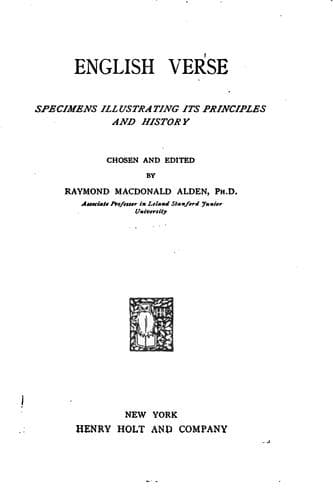
English Verse: Specimens Illustrating its Principles and HistoryAlden, Raymond MacDonald
General
English Verse: Specimens Illustrating its Principles and History
Alden, Raymond MacDonald
English language -- Versification; English poetry
[32] On Milton's verse, see, besides the entire third essay in Mr.
Symonds's book, Masson's edition of Milton, vol. iii. pp. 107-133;
Robert Bridges's _Milton's Prosody_; Mayor's _Chapters on English
Metre_, 2d ed., pp. 71-77 and 96-105; chapter xii. of Corson's _Primer
of English Verse_; and a passage in De Quincey's essay on "Milton v.
Southey and Landor," in his works, ed. Masson, vol. xi. pp. 463 ff. Says
De Quincey: "You might as well tax Mozart with harshness in the divinest
passages of _Don Giovanni_ as Milton with any such offence against
metrical science. Be assured it is yourself that do not read with
understanding, not Milton that by possibility can be found deaf to the
demands of perfect harmony."
[33] Aaron Hill (1685-1750), an admirer of Thomson, wrote a "Poem in
Praise of Blank Verse," opening:
"Up from Rhyme's poppied vale! and ride the storm That thunders in blank
verse!"
On the other hand, there were not wanting protestants against the form,
like Dr. Johnson and Goldsmith (see above, p. 205). Robert Lloyd
(1733-1764) wrote:
"Some Milton-mad (an affectation Glean'd up from college-education)
Approve no verse, but that which flows In epithetic measur'd prose;...
the metre which they call Blank, classic blank, their all in all."
(Quoted in Perry's _English Literature in the Eighteenth Century_, p.
385.)
[34] On its analysis, see Mayor's _Chapters on English Metre_, 2d ed.,
chap. xiii.
III. SIX-STRESS AND SEVEN-STRESS VERSE
A.--THE ALEXANDRINE (IAMBIC HEXAMETER)
The alexandrine was introduced into English from French verse, as early
(according to Schipper) as the early part of the thirteenth century.
Early poems in this metre alone, however, are almost wholly wanting, if
they ever existed. The early alexandrines usually appear in conjunction
with the septenary (seven-stress verse). The French alexandrine has
almost always been characterized by a regular and strongly marked medial
cesura, and this very commonly appears in the English form, but by no
means universally.
The French alexandrine is of uncertain origin. Kawczynski would trace it
to the classical Asclepiadean verse, as in
"Mæcenas atavis edite regibus,"
Public-domain text, read in full here on John Shaqi.
Reviews
Reviews
No reviews yet
Be the first to share your thoughts on this work.
Elsewhere in the archive
Join the Discussion
Join the discussion
Sign in to leave a comment or review.
Sign InorCreate an account