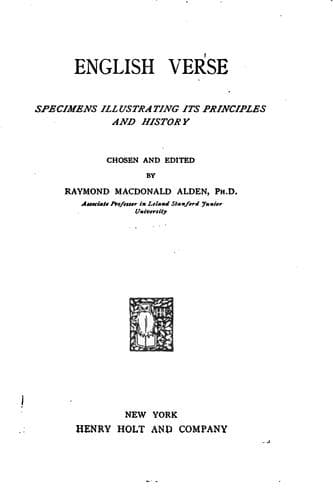
English Verse: Specimens Illustrating its Principles and HistoryAlden, Raymond MacDonald
General
English Verse: Specimens Illustrating its Principles and History
Alden, Raymond MacDonald
English language -- Versification; English poetry
Drummond was a sonneteer of great skill, and used many original
combinations of rime-schemes,--some forty in all,--yet usually
approximating to the Italian type. Leigh Hunt says: "Drummond's sonnets,
for the most part, are not only of the legitimate order, but they are
the earliest in the language that breathe what may be called the habit
of mind observable in the best Italian writers of sonnets; that is to
say, a mixture of tenderness, elegance, love of country, seclusion, and
conscious sweetness of verse." (Essay on the Sonnet, in _The Book of the
Sonnet_, vol. i. pp. 78, 79.)
Death, be not proud, though some have called thee
Mighty and dreadful, for thou art not so;
For those whom thou think'st thou dost overthrow
Die not, poor Death; nor yet canst thou kill me.
From rest and sleep, which but thy pictures be,
Much pleasure: then from thee much more must flow;
And soonest our best men do with thee go--
Rest of their bones, and souls' delivery.
Thou'rt slave to fate, chance, kings, and desperate men,
And dost with poison, war, and sickness dwell,
And poppy or charms can make us sleep as well
And better than thy stroke. Why swell'st thou then?
One short sleep past, we wake eternally,
And death shall be no more: Death, thou shalt die.
(JOHN DONNE: _Holy Sonnets_, X. 1635.)
Donne's series of "Holy Sonnets" was one of the few Elizabethan
sequences, or cycles, which dealt with other than amatory subjects. The
seven sonnets of the series called _La Corona_ are bound together into a
"crown of sonnets,"--an Italian fashion, according to which the first
line of each sonnet is the same as the last of the sonnet preceding, and
the last line of the last sonnet the same as the first line of the
first.
When I consider how my light is spent
Ere half my days, in this dark world and wide,
And that one talent which is death to hide
Lodged with me useless, though my soul more bent
To serve therewith my Maker, and present
My true account, lest He returning chide,--
Doth God exact day-labor, light denied?
I fondly ask:--But patience, to prevent
That murmur, soon replies: God doth not need
Either man's work, or His own gifts; who best
Bear His mild yoke, they serve Him best: His state
Is kingly; thousands at His bidding speed
And post o'er land and ocean without rest:--
They also serve who only stand and wait.
(MILTON: _On his Blindness_. ab. 1655.)
Milton learned the sonnet direct from the Italian, and wrote five in
that language. While following the Italian rime-schemes, however, he was
not careful to observe any division between octave and sestet. Like
Donne, he turned the sonnet to other subjects than that of love, or--in
Landor's words--
"He caught the sonnet from the dainty hand
Of Love, who cried to lose it, and he gave
The notes to Glory."
(_To Lamartine._)
Compare, also, Wordsworth's saying that in Milton's hand
Public-domain text, read in full here on John Shaqi.
Reviews
Reviews
No reviews yet
Be the first to share your thoughts on this work.
Elsewhere in the archive
Join the Discussion
Join the discussion
Sign in to leave a comment or review.
Sign InorCreate an account