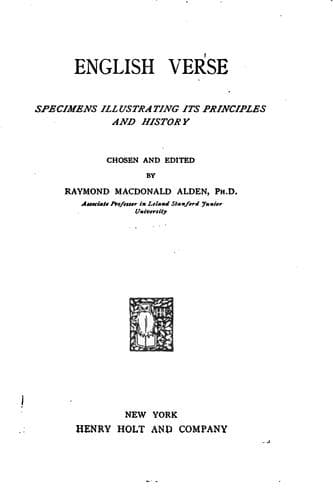
English Verse: Specimens Illustrating its Principles and HistoryAlden, Raymond MacDonald
General
English Verse: Specimens Illustrating its Principles and History
Alden, Raymond MacDonald
English language -- Versification; English poetry
The original impulse toward this classical or pseudo-classical
verse was a product of the Renaissance, when all forms of art not
based on Greek and Latin models were suspected. Rime, not being
found in the poetry of the classical languages, was treated as a
product of the dark ages,--the invention of "Goths and Huns." See
Roger Ascham's _Schoolmaster_ (1570) for the most characteristic
representative of this phase of thought in England. The new forms
of verse were, naturally enough, first tried in Italy. Schipper
traces the beginning of the movement to Alberti (1404-1484). A
century later Trissino wrote his _Sophonisbe_ and _Italia Liberata_
in unrimed verse, in professed imitation of Homer, and was looked
upon as the inventor of _versi sciolti_, that is, verses "freed"
from rime (compare the remarks of Milton in the prefatory note to
_Paradise Lost_). In 1539 Claudio Tolomei wrote _Versi e Regole
della Poesia Nuova_, a systematic attempt to introduce the
classical versification. He also wrote hexameters and sapphics. In
France there were similar efforts in the sixteenth century. Mousset
translated Homer into hexameters in 1530, and A. de Baïf, a member
of the "Pleiade" (1532-1589), devised some French hexameters which
he called _vers baïfins_. The English experiments were worked out
independently, and yet under the same neo-classical influences. On
this subject, see Schipper, vol. ii. pp. 2-12, 439-464.
A.--LYRICAL MEASURES
Reason, tell me thy mind, if here be reason
In this strange violence, to make resistance
Where sweet graces erect the stately banner
Of Virtue's regiment, shining in harness
Of Fortune's diadems, by Beauty mustered:
Say, then, Reason, I say, what is thy counsel?
(SIR PHILIP SIDNEY: _Phaleuciakes_, from the _Arcadia_, ab. 1580.)
This is the measure commonly called "Phalæcian." Compare Tennyson's
imitation of it, in his Hendecasyllabics quoted below.
O sweet woods, the delight of solitariness!
O how much I do like your solitariness!
Where man's mind hath a freed consideration
Of goodness to receive lovely direction.
Where senses do behold the order of heavenly host,
And wise thoughts do behold what the Creator is.
(SIR PHILIP SIDNEY: _Asclepiadics_, from the _Arcadia_. ab. 1580.)
This is the measure now called "Lesser Asclepiadean."
My Muse, what ails this ardor
To blaze my only secrets?
Alas, it is no glory
To sing my own decay'd state.
Alas, it is no comfort
To speak without an answer;
Alas, it is no wisdom
To show the wound without cure.
(SIR PHILIP SIDNEY: _Anacreontics_, from the _Arcadia_. ab. 1580.)
Public-domain text, read in full here on John Shaqi.
Reviews
Reviews
No reviews yet
Be the first to share your thoughts on this work.
Elsewhere in the archive
Join the Discussion
Join the discussion
Sign in to leave a comment or review.
Sign InorCreate an account