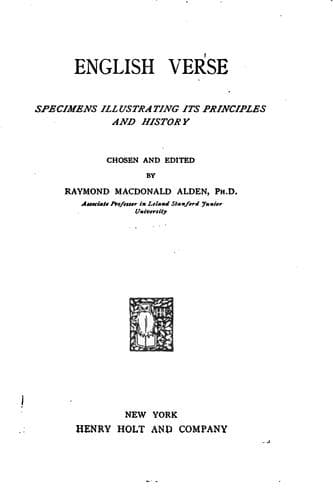
English Verse: Specimens Illustrating its Principles and HistoryAlden, Raymond MacDonald
General
English Verse: Specimens Illustrating its Principles and History
Alden, Raymond MacDonald
English language -- Versification; English poetry
reader to a height of desirable excitement, then (unless the poet's
choice of his metre has been grossly injudicious), in the feelings of
pleasure which the reader has been accustomed to connect with metre in
general, and in the feeling, whether cheerful or melancholy, which he
has been accustomed to connect with that particular movement of metre,
there will be found something which will greatly contribute to impart
passion to the words, and to effect the complex end which the poet
proposes to himself.
If I had undertaken a systematic defence of the theory here maintained,
it would have been my duty to develop the various causes upon which the
pleasure received from metrical language depends. Among the chief of
these causes is to be reckoned a principle which must be well known to
those who have made any of the Arts the object of accurate reflection;
namely, the pleasure which the mind derives from the perception of
similitude in dissimilitude. This principle is the great spring of the
activity of our minds, and their chief feeder.... It would not be a
useless employment to apply this principle to the consideration of
metre, and to show that metre is hence enabled to afford much pleasure,
and to point out in what manner that pleasure is produced. But my limits
will not permit me to enter upon this subject, and I must content myself
with a general summary.
I have said that poetry is the spontaneous overflow of powerful
feelings; it takes its origin from emotion recollected in tranquillity;
the emotion is contemplated till, by a species of reaction, the
tranquillity gradually disappears, and an emotion, kindred to that which
was before the subject of contemplation, is gradually produced, and does
itself actually exist in the mind. In this mood successful composition
generally begins, and in a mood similar to this it is carried on; but
the emotion, of whatever kind, and in whatever degree, from various
causes, is qualified by various pleasures, so that in describing any
passions whatsoever, which are voluntarily described, the mind will,
upon the whole, be in a state of enjoyment. If Nature be thus cautious
to preserve in a state of enjoyment a being so employed, the Poet ought
to profit by the lesson held forth to him, and ought especially to take
care that, whatever passions he communicates to his reader, those
passions, if his reader's mind be sound and vigorous, should always be
accompanied with an overbalance of pleasure. Now the music of harmonious
metrical language, the sense of difficulty overcome, and the blind
association of pleasure which has been previously received from works of
rime or metre of the same or similar construction, an indistinct
perception perpetually renewed of language closely resembling that of
real life, and yet, in the circumstance of metre, differing from it so
widely--all these imperceptibly make up a complex feeling of delight,
which is of the most important use in tempering the painful feeling
Public-domain text, read in full here on John Shaqi.
Reviews
Reviews
No reviews yet
Be the first to share your thoughts on this work.
Elsewhere in the archive
Join the Discussion
Join the discussion
Sign in to leave a comment or review.
Sign InorCreate an account