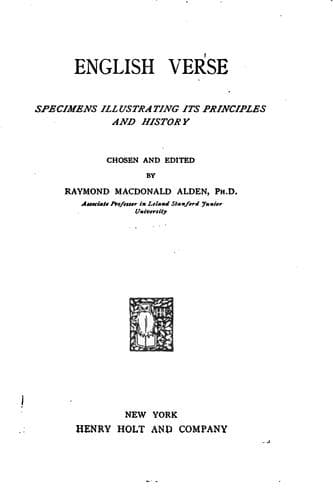
English Verse: Specimens Illustrating its Principles and HistoryAlden, Raymond MacDonald
General
English Verse: Specimens Illustrating its Principles and History
Alden, Raymond MacDonald
English language -- Versification; English poetry
always found intermingled with powerful descriptions of the deeper
passions. This effect is always produced in pathetic and impassioned
poetry; while, in lighter compositions, the ease and gracefulness with
which the Poet manages his numbers are themselves confessedly a
principal source of the gratification of the reader. All that it is
necessary to say, however, upon this subject, may be effected by
affirming, what few persons will deny, that of two descriptions, either
of passions, manners, or characters, each of them equally well executed,
the one in prose and the other in verse, the verse will be read a
hundred times where the prose is read once.
(WORDSWORTH: Preface to the _Lyrical Ballads_, 2d ed.)
The true question must be,[57] whether there are not modes of
expression, a construction, and an order of sentences, which are in
their fit and natural place in a serious prose composition, but would be
disproportionate and heterogeneous in metrical poetry; and, _vice
versa_, whether in the language of a serious poem there may not be an
arrangement both of words and sentences, and a use and selection of
(what are called) figures of speech, both as to their kind, their
frequency, and their occasions, which on a subject of equal weight would
be vicious and alien in correct and manly prose. I contend that in both
cases this unfitness of each for the place of the other frequently will
and ought to exist. And, first, from the origin of metre. This I would
trace to the balance in the mind effected by the spontaneous effort
which strives to hold in check the workings of passion. It might be
easily explained likewise in what manner this salutary antagonism is
assisted by the very state which it counteracts; and how this balance
of antagonists became organized into metre (in the usual acceptation of
that term) by a supervening act of the will and judgment, consciously
and for the foreseen purpose of pleasure. Assuming these principles as
the data of our argument, we deduce from them two legitimate conditions,
which the critic is entitled to expect in every metrical work. First,
that as the elements of metre owe their existence to a state of
increased excitement, so the metre itself should be accompanied by the
natural language of excitement. Secondly, that as these elements are
formed into metre artificially, by a voluntary act, with the design and
for the purpose of blending delight with emotion, so the traces of
present volition should throughout the metrical language be
proportionally discernible....
Public-domain text, read in full here on John Shaqi.
Reviews
Reviews
No reviews yet
Be the first to share your thoughts on this work.
Elsewhere in the archive
Join the Discussion
Join the discussion
Sign in to leave a comment or review.
Sign InorCreate an account