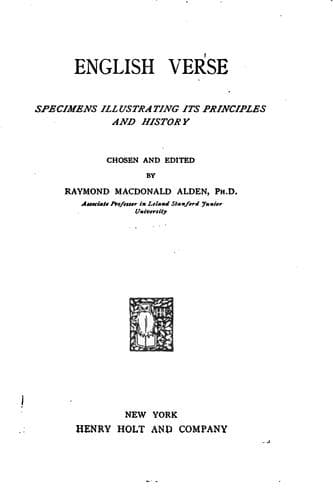
English Verse: Specimens Illustrating its Principles and HistoryAlden, Raymond MacDonald
General
English Verse: Specimens Illustrating its Principles and History
Alden, Raymond MacDonald
English language -- Versification; English poetry
Secondly, I argue from the effects of metre. As far as metre acts in and
for itself, it tends to increase the vivacity and susceptibility both of
the general feelings and of the attention. This effect it produces by
the continued excitement of surprise, and by the quick reciprocations of
curiosity still gratified and still re-excited, which are too slight
indeed to be at any moment objects of distinct consciousness, yet become
considerable in their aggregate influence. As a medicated atmosphere, or
as wine during animated conversation, they act powerfully, though
themselves unnoticed. Where, therefore, correspondent food and
appropriate matter are not provided for the attention and feelings thus
roused, there must needs be disappointment felt;--like that of leaping
in the dark from the last step of a staircase, when we had prepared our
muscles for a leap of three or four.
The discussion on the powers of metre, in the Preface, is highly
ingenious, and touches at all points on truth. But I cannot find any
statement of its powers considered abstractly and separately. On the
contrary, Mr. Wordsworth seems always to estimate metre by the powers
which it exerts during (and, as I think, in consequence of) its
combination with other elements of poetry. Thus the previous difficulty
is left unanswered, what the elements are with which it must be combined
in order to produce its own effects to any pleasurable purpose.... For
any poetic purposes, metre resembles (if the aptness of the simile may
excuse its meanness) yeast, worthless or disagreeable by itself, but
giving vivacity and spirit to the liquor with which it is proportionally
combined....
Metre in itself is simply a stimulant of the attention, and therefore
excites the question, Why is the attention to be thus stimulated? Now
the question cannot be answered by the pleasure of the metre itself; for
this we have shown to be conditional, and dependent on the
appropriateness of the thoughts and expressions to which the metrical
form is superadded. Neither can I conceive any other answer that can be
rationally given, short of this: I write in metre, because I am about to
use a language different from that of prose....
Thirdly, I deduce the position from all the causes elsewhere assigned
which render metre the proper form of poetry, and poetry imperfect and
defective without metre. Metre, therefore, having been connected with
poetry most often, and by a peculiar fitness, whatever else is combined
with metre must, though it be not itself essentially poetic, have
nevertheless some property in common with poetry, as an intermedium of
affinity.
(COLERIDGE: _Biographia Literaria_, chap. xviii.)
Public-domain text, read in full here on John Shaqi.
Reviews
Reviews
No reviews yet
Be the first to share your thoughts on this work.
Elsewhere in the archive
Join the Discussion
Join the discussion
Sign in to leave a comment or review.
Sign InorCreate an account