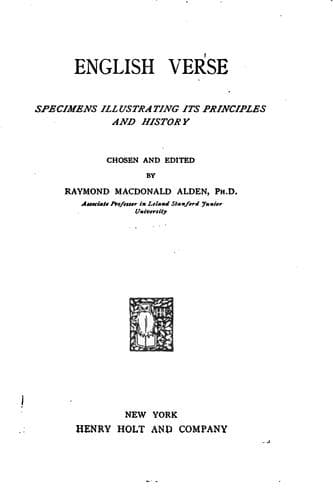
English Verse: Specimens Illustrating its Principles and HistoryAlden, Raymond MacDonald
General
English Verse: Specimens Illustrating its Principles and History
Alden, Raymond MacDonald
English language -- Versification; English poetry
In the youth of the world, men dance and sing and imitate natural
objects, observing in these actions, as in all others, a certain rhythm
or order. And, although all men observe a similar, they observe not the
same order, in the motions of the dance, in the melody of the song, in
the combinations of language, in the series of their imitations of
natural objects. For there is a certain order or rhythm belonging to
each of these classes of mimetic representation, from which the hearer
and the spectator receive an intenser and purer pleasure than from any
other: the sense of an approximation to this order has been called taste
by modern writers....
Language, color, form, and religious and civil habits of action are all
the instruments and materials of poetry; and they may be called poetry
by that figure of speech which considers the effect as a synonym of the
cause. But poetry in a more restricted sense expresses those
arrangements of language, and especially metrical language, which are
created by that imperial faculty whose throne is curtained within the
invisible nature of man. And this springs from the nature itself of
language, which is a more direct representation of the actions and
passions of our internal being, and is susceptible of more various and
delicate combinations than color, form, or motion, and is more plastic
and obedient to the control of that faculty of which it is the
creation.... Sounds as well as thoughts have relation both between each
other and towards that which they represent, and a perception of the
order of those relations has always been found connected with a
perception of the order of the relations of thoughts. Hence the language
of poets has ever affected a certain uniform and harmonious recurrence
of sound, without which it were not poetry, and which is scarcely less
indispensable to the communication of its influence than the words
themselves, without reference to that peculiar order.... An observation
of the regular mode of the recurrence of harmony in the language of
poetical minds, together with its relation to music, produced metre, or
a certain system of traditional forms of harmony and language. Yet it is
by no means essential that a poet should accommodate his language to
this traditional form, so that the harmony, which is its spirit, be
observed.
(SHELLEY: _A Defence of Poetry_.)
Poetry, in its matter and form, is natural imagery or feeling, combined
with passion and fancy. In its mode of conveyance, it combines the
ordinary use of language with musical expression. There is a question of
long standing in what the essence of poetry consists, or what it is that
determines why one set of ideas should be expressed in prose, another in
verse. Milton has told us his idea of poetry in a single line:
"Thoughts that voluntary move
Harmonious numbers."
Public-domain text, read in full here on John Shaqi.
Reviews
Reviews
No reviews yet
Be the first to share your thoughts on this work.
Elsewhere in the archive
Join the Discussion
Join the discussion
Sign in to leave a comment or review.
Sign InorCreate an account