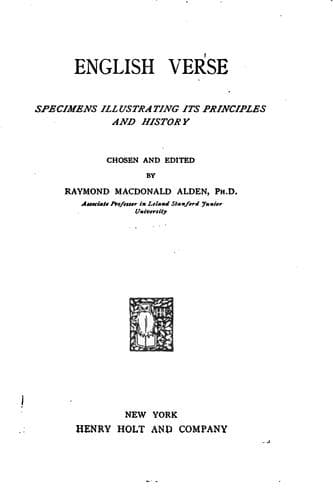
English Verse: Specimens Illustrating its Principles and HistoryAlden, Raymond MacDonald
General
English Verse: Specimens Illustrating its Principles and History
Alden, Raymond MacDonald
English language -- Versification; English poetry
As there are certain sounds that excite certain movements, and the song
and dance go together, so there are, no doubt, certain thoughts that
lead to certain tones of voice, or modulations of sound, and change "the
words of Mercury into the songs of Apollo." ... The jerks, the breaks,
the inequalities and harshnesses of prose are fatal to the flow of a
poetical imagination, as a jolting road or a stumbling horse disturbs
the reverie of an absent man. But poetry "makes these odds all even." It
is the music of language, answering to the music of the mind, untying,
as it were, "the secret soul of harmony." Wherever any object takes such
a hold of the mind as to make us dwell upon it, and brood over it,
melting the heart in tenderness, or kindling it to a sentiment of
enthusiasm; wherever a movement of imagination or passion is impressed
on the mind, by which it seeks to prolong and repeat the emotion, to
bring all other objects into accord with it, and to give the same
movement of harmony, sustained and continuous, or gradually varied,
according to the occasion, to the sounds that express it--this is
poetry. The musical in sound is the sustained and continuous; the
musical in thought is the sustained and continuous also. There is a near
connection between music and deep-rooted passion. Mad people sing. As
often as articulation passes naturally into intonation, there poetry
begins.... It is to supply the inherent defect of harmony in the
customary mechanism of language, to make the sound an echo to the sense,
when the sense becomes a sort of echo to itself--to mingle the tide of
verse, "the golden cadences of poetry," with the tide of feeling,
flowing and murmuring as it flows--in short, to take the language of the
imagination from off the ground; and enable it to spread its wings where
it may indulge its own impulses:
"Sailing with supreme dominion
Through the azure deep of air,"
without being stopped, or fretted, or diverted with the abruptnesses and
petty obstacles, and discordant flats and sharps of prose, that poetry
was invented. It is to common language what springs are to a carriage,
or wings to feet. In ordinary speech we arrive at a certain harmony by
the modulations of the voice; in poetry the same thing is done
systematically by a regular collocation of syllables. It has been well
observed, that every one who declaims warmly, or grows intent upon a
subject, rises into a sort of blank verse or measured prose.... An
excuse might be made for rime in the same manner. It is but fair that
the ear should linger on the sounds that delight it, or avail itself of
the same brilliant coincidence and unexpected recurrence of syllables,
that have been displayed in the invention and collocation of images. It
is allowed that rime assists the memory.... But if the jingle of names
assists the memory, may it not also quicken the fancy?
(WILLIAM HAZLITT: _On Poetry in General_.)
Public-domain text, read in full here on John Shaqi.
Reviews
Reviews
No reviews yet
Be the first to share your thoughts on this work.
Elsewhere in the archive
Join the Discussion
Join the discussion
Sign in to leave a comment or review.
Sign InorCreate an account