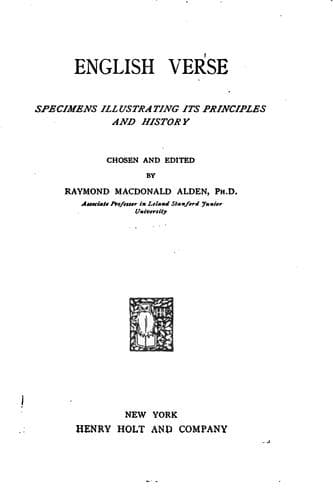
English Verse: Specimens Illustrating its Principles and HistoryAlden, Raymond MacDonald
General
English Verse: Specimens Illustrating its Principles and History
Alden, Raymond MacDonald
English language -- Versification; English poetry
With regard to the principle of Variety in Uniformity by which verses
ought to be modulated, and oneness of impression diversely produced, it
has been contended by some that poetry need not be written in verse at
all; that prose is as good a medium, provided poetry be conveyed through
it, and that to think otherwise is to confound letter with spirit, or
form with essence. But the opinion is a prosaical mistake. Fitness and
unfitness for _song_, or metrical excitement, just make all the
difference between a poetical and prosaical subject; and the reason why
verse is necessary to the form of poetry is that the perfection of
poetical spirit demands it--that the circle of its enthusiasm, beauty,
and power is incomplete without it. I do not mean that a poet can never
show himself a poet in prose; but that being one, his desire and
necessity will be to write in verse; and that, if he were unable to do
so, he would not and could not deserve his title. Verse to the true poet
is no clog. It is idly called a trammel and a difficulty. It is a help.
It springs from the same enthusiasm as the rest of his impulses, and is
necessary to their satisfaction and effect.... Verse is the final proof
to the poet that his mastery over his art is complete. It is the
shutting up of his powers in "_measureful_ content"; the answer of form
to his spirit; of strength and ease to his guidance.... Verse, in short,
is that finishing, and rounding, and "tuneful planeting" of the poet's
creations which is produced of necessity by the smooth tendencies of
their energy or inward working, and the harmonious dance into which they
are attracted round the orb of the beautiful. Poetry, in its complete
sympathy with beauty, must of necessity leave no sense of the beautiful,
and no power over its forms, unmanifested; and verse flows as inevitably
from this condition of its integrity as other laws of proportion do from
any other kind of embodiment of beauty....
Every poet, then, is a versifier; every fine poet an excellent one; and
he is the best whose verse exhibits the greatest amount of strength,
sweetness, straightforwardness, unsuperfluousness, variety, and
oneness;--oneness, that is to say, consistency in the general
impression, metrical and moral; and variety, or every pertinent
diversity of tone and rhythm, in the process.... It is thus that
versification itself becomes part of the sentiment of a poem, and
vindicates the pains that have been taken to show its importance. I know
of no very fine versification unaccompanied with fine poetry; no poetry
of a mean order accompanied with verse of the highest.
(LEIGH HUNT: _What is Poetry?_ Cook ed., pp. 37-40, 61.)
Public-domain text, read in full here on John Shaqi.
Reviews
Reviews
No reviews yet
Be the first to share your thoughts on this work.
Elsewhere in the archive
Join the Discussion
Join the discussion
Sign in to leave a comment or review.
Sign InorCreate an account