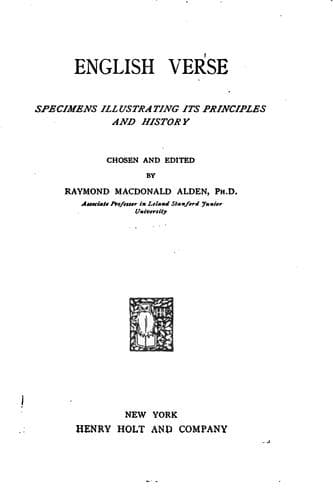
English Verse: Specimens Illustrating its Principles and HistoryAlden, Raymond MacDonald
General
English Verse: Specimens Illustrating its Principles and History
Alden, Raymond MacDonald
English language -- Versification; English poetry
No literary expression can, properly speaking, be called poetry that is
not in a certain deep sense emotional, whatever may be its
subject-matter, concrete in its method and its diction, rhythmical in
movement, and artistic in form.... That poetry must be metrical or even
rhythmical in movement, however, is what some have denied. Here we touch
at once the very root of the subject.... While prose requires
intellectual life and emotional life, poetry seems to require not only
intellectual life and emotional life but rhythmic life.... Unless the
rhythm of any metrical passage is so vigorous, so natural, and so free
that it seems as though it could live, if need were, by its rhythm
alone, has that passage any right to exist? and should it not, if the
substance is good, be forthwith demetricized and turned into prose? ...
Aristotle ignored, and Plato slighted, the importance of versification
(though Plato on one occasion admitted that he who did not know rhythm
could be called neither musician nor poet).... On the whole, however,
the theory that versification is not an indispensable requisite of a
poem seems to have become nearly obsolete in our time. Perhaps, indeed,
many critics would now go so far in the contrary direction as to say
with Hegel (_Æsthetik_, iii. p. 289) that "metre is the first and only
condition absolutely demanded by poetry, yea even more necessary than a
figurative picturesque diction."
(THEODORE WATTS: Article on "Poetry" in _Encyclopædia Britannica_.)
Verse-rhythm in words is the imposition of a _sensible_ order on what
naturally and normally has only a _logical_ order; and there is piquancy
in the feeling that so little is this ideal control a fettering
instrument, that each order seems to gain verve and spontaneity from the
other, or rather from the latent sense that the other, though present
and operative, is powerless to hamper it. Much more important, however,
is it to notice how the sense that one single thing--the word-series--is
lending itself to this joint dominance may take the form of a sort of
transfigured surprise. (The root-principle here involved is the old one
of "unity in variety," the _single_ line of words, "dominated at once by
the idea which they express in their grammatical connection and by their
metrical adjustment," clearly possessing _two_ independent functions or
aspects. See the fuller discussion of "The Sound-element in Verse," in
chapter xix. of _The Power of Sound_.) ... When, as in verse, the sounds
are pointedly addressed _both_ to the ear and to the understanding, the
rarity of the combination of aspects contributes a strain of feeling
partly akin to that with which we follow an exhibition of skill, and
partly to that with which we receive an unexpected gratuity....
Public-domain text, read in full here on John Shaqi.
Reviews
Reviews
No reviews yet
Be the first to share your thoughts on this work.
Elsewhere in the archive
Join the Discussion
Join the discussion
Sign in to leave a comment or review.
Sign InorCreate an account