Produced by Chris Curnow, Wayne Hammond and the Online
Distributed Proofreading Team at http://www.pgdp.net (This
file was produced from images generously made available
by The Internet Archive)
[Transcriber’s Note:
Text delimited by underscores is italics.
Text delimited by pound signs (#) is gesperrt.]
#ENGRAVED GEMS#
ENGRAVED GEMS
BY
MAXWELL SOMMERVILLE
PROFESSOR OF GLYPTOLOGY, UNIVERSITY OF PENNSYLVANIA; AUTHOR OF “SANDS
OF SAHARA,” “SIAM,” ETC.; CORRESPONDING MEMBER OF THE SOCIÉTÉ
ACADÉMIQUE DES SCIENCES, ARTS ET BELLES-LETTRES
DU DÉPARTEMENT DE L’AUBE,
FRANCE, ETC.
[Illustration]
DREXEL BIDDLE, PUBLISHER
PHILADELPHIA LONDON
SAN FRANCISCO TORONTO
1901
COPYRIGHT, 1901
BY
MAXWELL SOMMERVILLE
PRINTED BY
DREXEL BIDDLE
PHILADELPHIA LONDON
PREFACE.
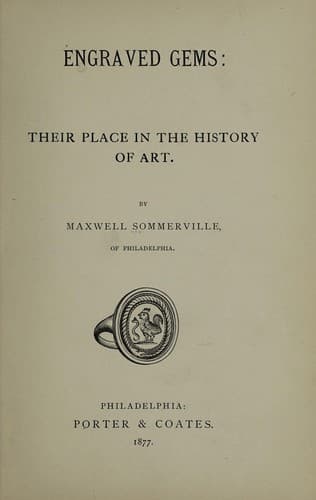
My former treatise, “Engraved Gems, their Place in the History of Art,”
being largely illustrated and inconvenient in size, I have abridged the
work and with new material prepared this volume.
The various epochs of gem engraving from the earliest eras down to the
XVIII. century are briefly described.
Many people throughout the year cast passing glances at my glyptic
collection in the Free Museum of Science and Art of the University of
Pennsylvania.
They express great admiration of the beautiful objects in stones of
many colors and interesting designs.
It was never intended to make only an attractive display; what I have
always desired and hoped for was that a proportion of our visitors
would recognize in my life’s work a contribution to science.
It is a classified representation of the glyptic work of more than
forty centuries, so carefully arranged that those who care to learn
through the medium of those beautiful engraved stones, cylinders,
seals, and Gnostic tokens, may inform themselves intelligently on the
science which these gems of all epochs so thoroughly exemplify.
Men in this Western World during the last three hundred years have been
engrossed in the pursuit and acquisition of fortunes.
A fair proportion of the population now having secured competency, that
condition once assured, with increased opportunities for intellectual
culture and the enjoyment of art, the development of refined tastes
and pursuits in America has been marked by the formation of many
private collections. Amateurs have gradually become connoisseurs in
manuscripts, ceramics, enamels, engravings, ancient coins, armor,
and arms. Happily, each is engrossed in his particular branch of
antiquities.
It is to be hoped that we may all profit by their researches, and that
the antique objects acquired by them may be stored in the Archæological
Museums of the world, that all who will may view them and learn from
them.
MAXWELL SOMMERVILLE.
Public-domain text, read in full here on John Shaqi.
Reviews
Reviews
No reviews yet
Be the first to share your thoughts on this work.
Join the Discussion
Join the discussion
Sign in to leave a comment or review.
Sign InorCreate an account