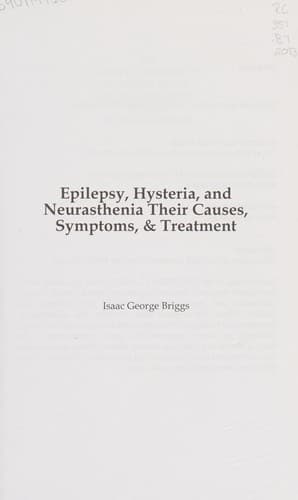
Epilepsy, Hysteria, and Neurasthenia: Their Causes, Symptoms, & TreatmentBriggs, Isaac George
Science
Epilepsy, Hysteria, and Neurasthenia: Their Causes, Symptoms, & Treatment
Briggs, Isaac George
Epilepsy; Hysteria; Nervous system -- Diseases; Neurasthenia
Try suggestion for fears and impulses (see Chapter XVIII), for it is
useless to try to "reason them out", though it is useful for a brief period
each day to try deliberately to turn the mind away from the obsession, by
singing or whistling, gradually prolonging the attempts.
Rest, to prevent the manufacture of more waste products, the elimination of
those present, and the generation of nerve-strength from nourishing food
are the things that cure. Chapters XIX and XX deal with the drug treatment.
Do not Worry. Whatever your trouble is, it is useless to
"Look before and after, and sigh for what is not"
for the future cannot be rushed nor the past remedied. All patients reply
promptly that they "can't help" worrying, when in truth they do not try.
Work never hurt anyone, but harassing preoccupation with problems which no
amount of thought will solve drives many thousands to early graves. Anger
exhausts itself in a few minutes, fatigue in a few hours, and real overwork
with a week's rest, but worry grows ever worse. Ponder Meredith's lines:
"I _will_ endure; I will not strive to peep
Behind the barrier of the days to come."
"Look on the bright side!" said an optimist to a melancholy friend.
"But there is no bright side."
"Then polish up the dull one!" was the sound advice tendered.
_Learn to forget_!
One cannot open a periodical without being exhorted to train one's memory
for a variety of reasons. The neuropath needs a system of forgetfulness.
Lethe is often a greater friend than Mnemosyne.
To brood on disappointments, failures and griefs only wastes energy, sours
temper, and upsets the general health. Resolve _beforehand_ that when
unhappy ideas arise you will _not_ dwell on them, but turn your thoughts to
pleasant trifles; take up a humorous book, or take a turn in the fresh air,
and you will soon acquire the habit of laughing instead of whining at Fate.
To sum up: Go slow! Your neurons have been exhausted in your foolish
attempt to "live this day as if thy last" in a wrong sense; feverish
activity and unnecessary work must be abandoned to enable the nerves to
recuperate.
When the doctor says "rest", he means "_rest_", not change your bustle from
work to what you are pleased to regard as play.
So much is _absolute rest_ recognized as the foundation of treatment, that
severe cases undergo the "Weir-Mitchell Treatment". The patient is _utterly
secluded_; letters, reading, talking, smoking and visits from friends are
forbidden. He is put to bed, not allowed even to sit up, sees no one save
nurse and doctor, is massaged, treated electrically, grossly overfed,
fattened up, and freed from every care.
Public-domain text, read in full here on John Shaqi.
Reviews
Reviews
No reviews yet
Be the first to share your thoughts on this work.
Join the Discussion
Join the discussion
Sign in to leave a comment or review.
Sign InorCreate an account