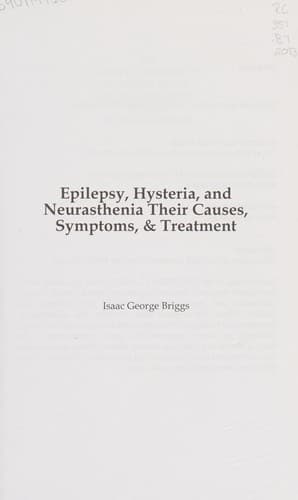
Epilepsy, Hysteria, and Neurasthenia: Their Causes, Symptoms, & TreatmentBriggs, Isaac George
Science
Epilepsy, Hysteria, and Neurasthenia: Their Causes, Symptoms, & Treatment
Briggs, Isaac George
Epilepsy; Hysteria; Nervous system -- Diseases; Neurasthenia
In leaving his habitual circle, the patient escapes the too-attentive care
of his relatives, and the incessant questions about his complaint with
which they overwhelm him. The results of this regime with semi-insane
wrecks are marvellous. It is a very drastic but very successful
"rest-cure", and while it cannot be undergone at home, neurasthenics will
benefit by following its principles as far as they can in their own homes.
High-frequency or static electricity sometimes works wonders in the hands
of a specialist, but the electric batteries, medical coils, finger-rings
and body-belts so persistently advertised are _useless_.
When the patient has in some measure recuperated, he may try the following
exercises in mental concentration. Vittoz claims good results from them,
but they must be done quite seriously.
1. Walk a few steps with the definite idea that you are putting forward
right and left feet alternately. Go on by easy stages until you
concentrate on the movement of the whole body.
2. Take any object in your hand, and note its exact form, weight,
colour, etc.
3. Look in a shop-window while you count ten, and as you walk on, try
to recall all the objects therein exhibited.
4. Accustom yourself to defining the sounds you hear, and concentrating
on a special one, as that of a passing tram, or a ticking watch.
5. Make a rapid examination several times daily of your feelings and
thoughts, and try to express them definitely.
6. Concentrate on the mental reproduction of a regular curve: a figure
8 placed on its side.
7. Listen to a metronome, and, a friend having stopped it, mentally
repeat the ticking to time.
8. Whenever you handle anything, try to retain the impression of that
object and its properties for several minutes, to the exclusion of
other ideas.
9. Concentrate on ideas of calm, and of energy controlled.
10. Place three objects on a sheet of white paper. Remove them one by
one, at the same time effacing the impression of each one as it is
removed, until the mind, like the paper, is blank.
11. Efface two of the objects, and retain the impression of one only.
12. Replace the impressions in your mind, but not the objects on the
paper, one by one.
The object of these exercises is to get your wandering mind daily a little
more under control; do not exhaust yourself.
After some months of treatment, ask yourself--
Public-domain text, read in full here on John Shaqi.
Reviews
Reviews
No reviews yet
Be the first to share your thoughts on this work.
Join the Discussion
Join the discussion
Sign in to leave a comment or review.
Sign InorCreate an account