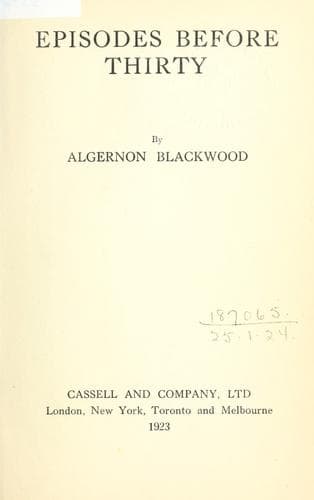
Authors, English -- 20th century -- Biography; Blackwood, Algernon, 1869-1951
He walked away, passing along the length of the room and down three
steps into a narrower, darker bar beyond, where the shadows hid him.
But his voice still reached me: “It’s on the back street, this bar,” he
called. “This is for the _hoi polloi_. We shall want a chucker out....
Here’s the private door leading to the upstairs dining-room we’ll let
out for banquets. We’ll have our own bedrooms and sitting-room on the
first floor too....”
His voice roared on; I heard, but did not answer; I had not moved an
inch from my place against the swing-doors. He had not, of course, the
faintest idea what was passing through my mind at the moment; and, had
I told him, he would only have laughed good-naturedly and talked of the
money we should make. The fact was, however, that the whole of my early
up-bringing just then came at me with a concentrated driving-force
which made the venture seem absolutely impossible.
“We’ll call this one the House of Commons,” he bawled delightedly; “and
that one--the front bar--the House of Lords. We shall take 250 dollars
a day easily!”
The shock, the contrast, the exaggerated effect of entering a saloon
for the first time in my life, especially with the added possibility of
shortly becoming its proprietor, were natural enough. My unworldliness,
even at twenty-one, was abnormal. Not only had I never smoked tobacco
nor touched alcohol of any description, but I had never yet set foot
inside a theatre; a race-course I had never seen, nor held a billiard
cue, nor touched a card. I did not know one card from another. Any game
that might involve betting or gambling was anathema. In other ways,
too, I had been sheltered to the point of ignorance. I had never even
danced. To hold a young woman round the waist was not alone immodest
but worse than immodest.
This peculiarly sheltered up-bringing, this protected hot-house of
boyhood and early youth to which a drinking bar was the vestibule of
hell, and a music-hall an invention of a personal devil, are necessary
to understand the reaction produced in me as I stood in Billy Bingham’s
“joint.” I stood, literally, on the brink of “the downward path.” I
heard my father’s voice, I saw my mother’s eyes.... In very definite
form I now faced “worldly temptation” they had so often warned me
against. Accompanying an almost audible memory of “Get thee behind
me, Satan,” drove a crowded kaleidoscope of vivid pictures from those
sheltered years.
Public-domain text, read in full here on John Shaqi.
Reviews
Reviews
No reviews yet
Be the first to share your thoughts on this work.
Join the Discussion
Join the discussion
Sign in to leave a comment or review.
Sign InorCreate an account