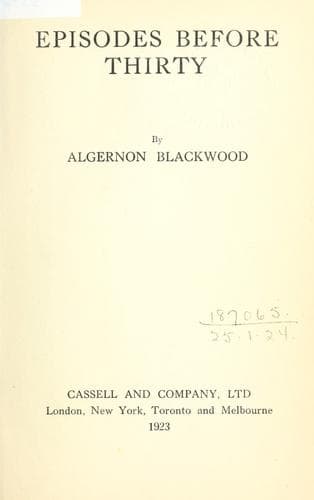
Authors, English -- 20th century -- Biography; Blackwood, Algernon, 1869-1951
My parents were both people of marked character, with intense
convictions; my mother, especially, being a woman of great
individuality, of iron restraint, grim humour, yet with a love and
tenderness, and a spirit of uncommon sacrifice, that never touched
weakness. She possessed powers of mind and judgment, at the same time,
of which my father, a public servant--financial secretary to the Post
Office--availed himself to the full. She had great personal beauty. A
young widow, her first husband having been the 6th Duke of Manchester,
also of the evangelical persuasion, she met my father at Kimbolton soon
after his return from the Crimean War, where he had undergone that
religious change of heart known to the movement as “conversion.” From
a man of fashion, a leader in the social life to which he was born,
he changed with sudden completeness to a leader in the evangelical
movement, then approaching its height. He renounced the world, the
flesh, the devil and all their works. The case of “Beauty Blackwood,”
to use the nickname his unusual handsomeness gained for him, was, in
its way, notorious. He became a teetotaller and non-smoker, wrote
devotional books, spoke in public, and held drawing-room prayer
meetings, the Bible always in his pocket, communion with God always
in his heart. His religion was genuine, unfaltering, consistent and
sincere. He carried the war into his own late world of fashion. He
never once looked back. He knew a vivid joy, a wondrous peace, his pain
being for others only, for those who were not “saved.” The natural,
instinctive type he was, asserted its claim. He became a genuine
saint. Also, to the very end, he remained that other delightful thing,
possible only to simple hearts, a boy.
Both my parents, thus, believed in Jesus, with a faith of that simple,
unshakable order that could feel no doubts. Their lives were consistent
and, as must always be the case when fine characters are possessed of a
perfectly sincere faith, they stood out in the world of men and women
as something strong and beautiful. Edmund Gosse, in “Father and Son,”
has described the mental attitude of the type; William James might,
equally, have included my father’s case as a typical “conversion” in
his “Varieties of Religious Experience.”
Public-domain text, read in full here on John Shaqi.
Reviews
Reviews
No reviews yet
Be the first to share your thoughts on this work.
Join the Discussion
Join the discussion
Sign in to leave a comment or review.
Sign InorCreate an account