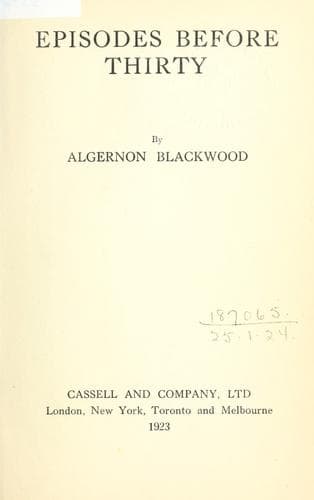
Authors, English -- 20th century -- Biography; Blackwood, Algernon, 1869-1951
“One conclusion was forced upon my mind ... and my impression of
its truth has ever since remained unshaken. It is that our normal
waking consciousness, rational consciousness as we call it, is but
_one special type_ of consciousness, whilst all about us, parted
from it by the filmiest of screens, there are potential forms of
consciousness entirely different. We may go through life without
suspecting their existence; but apply the requisite stimulus and at
a touch they are there in all their completeness; definite types of
mentality which probably somewhere have their field of application
and adaptation. No account of the universe in its totality can
be final which leaves these other forms of consciousness quite
disregarded. At any rate, they forbid a premature closing of our
accounts with reality. The whole drift of my education goes to
persuade me that the world of our present consciousness is _only
one_ out of many worlds of consciousness that exist, and that these
other worlds must contain experiences which have a meaning for our
life also.... [The insight in these other states] has a keynote
invariably of reconciliation. It is as if the opposites of the
world, whose contradictions and conflict make all our difficulties
and troubles, were melting into unity.”[1]
[1] “Varieties of Religious Experience.” William James.
The immortal may mingle with certain moods, perhaps, especially when
violent contrast underlies the transition, and when deep yearnings,
suppressed equally with violence, find their sudden radiant outlet.
Since those Bronx Park days, when Nature caught me with such profound,
uplifting magic, yet when thought was dumb and inarticulate, I am for
ever coming across neat expressions by better minds than mine of what I
then felt, and even believed I _knew_, in some unimagined way. Nature
drew me, perhaps, away from life, while at the same time there glowed
in my heart strange unrealizable desires to help life, to assist at her
Utopian development, to work myself to the bone for the improvement
of humanity. The contradiction, silly and high-flown though it now
sounds, was then true. Inextinguishable fires to this end blazed in
me, both mind and heart were literally on fire. My failure with Boyde,
my meanness with Calder, to mention no graver lapses, both bit deep,
but the intense longing to lose my Self in some Utopian cause was as
strong as the other longing to be lost in the heart of some unstained
and splendid wilderness of natural beauty. And the conflict puzzled me.
Being inarticulate, I could not even find relief in words, though, as
mentioned, I have often since discovered my feelings of those distant
days expressed neatly enough by others. Only a few days ago I came
across an instance:
“If Nature catches the soul young it is lost to humanity,” groans
Leroy, in a truly significant book of 1922.[2]
Public-domain text, read in full here on John Shaqi.
Reviews
Reviews
No reviews yet
Be the first to share your thoughts on this work.
Elsewhere in the archive
Join the Discussion
Join the discussion
Sign in to leave a comment or review.
Sign InorCreate an account