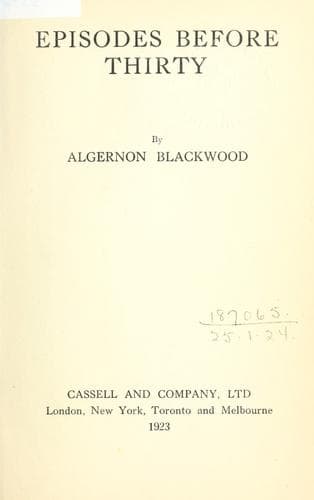
Authors, English -- 20th century -- Biography; Blackwood, Algernon, 1869-1951
A dozen years before, aged 12, I had once been accused of stealing by
the headmaster of the private school I adorned in Sevenoaks. I was
innocent, but the evidence was both ludicrous and damning, so damning,
indeed, that, strangely, I _felt_ guilty and accepted the punishment.
A terrifying experience, it haunted me for years, and the sight of a
policeman, or the words “criminal judge,” sent shivers down my spine
long afterwards. When a little older, I came to suspect that it was
worked up against me by the master to curry favour with an influential
parent; but at the actual time I had visions even of prison--for
something I had not done. All about a poem, too!
At evening “prep” a “bit of poetry,” as we called it, had to be learnt
by heart; my own poetry book was lost; I borrowed young Gildea’s.
The last thing in the world I wanted to own was that poetry book of
young Gildea, the last thing I wanted to do was to learn that poem by
heart. I spent the hour, therefore, inscribing my name with elaborate
flourishes on the title page. Twice I wrote it, with capitals, of which
I was very proud; I thought it ornate and beautiful; and when the hour
was over I tossed the book into my locker and forgot all about it.
Next morning I was summoned into the headmaster’s presence. He wore
red whiskers about an otherwise clean-shaven face: a face of natural
sternness, with a big nose, a mouth of iron, and steely blue eyes. He
was a clergyman of evangelical persuasion.
I had no idea why I had been summoned, but his glance made me at once
feel uneasy.
“Blackwood minor,” he said in a solemn and portentous voice, “did you
do--_this_?” He held out Gildea’s poetry book towards me with the cover
open. His finger pointed to my name in pencil, flourishes and all.
I was completely puzzled as to what was coming, but I admitted the
signature of course.
“Is the book yours?” he asked. I said it was not. “Gildea has reported
the loss of his own copy,” the voice of doom went on. “It has been
found--_in your locker_--and with _your name written_ in it.” The
voice made me think of “and God spake” in the Bible.
He looked at me in such a way that I felt sure I was going to be
flogged. What had I done? And why? I couldn’t quite remember. No
explanation came to me. The simple truth was too silly to mention. I
had nothing to say except to admit everything. The man, with his awful
manner and appalling aspect, terrified me. I stood speechless and
paralysed, wondering what was coming next. The red whiskers made me
think of Satan.
I little dreamed, however, that the headmaster would say what he then
did say. He spoke with a terribly slow, deliberate emphasis.
“This is as grave a case of stealing,” fell the awful words of
judgment, “as ever came before a _Criminal Judge_. I have sent for your
father.”
I was petrified. It was enough to frighten any boy into his boots.
Public-domain text, read in full here on John Shaqi.
Reviews
Reviews
No reviews yet
Be the first to share your thoughts on this work.
Elsewhere in the archive
Join the Discussion
Join the discussion
Sign in to leave a comment or review.
Sign InorCreate an account