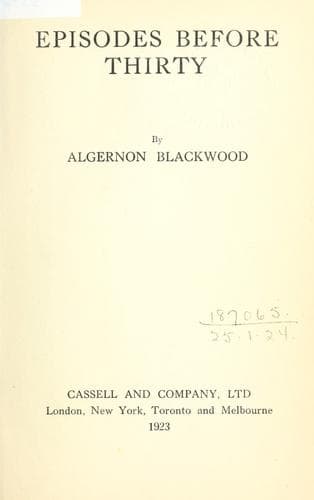
Authors, English -- 20th century -- Biography; Blackwood, Algernon, 1869-1951
“This is my partner, Mr. Blackwood,” he was saying, as he came from the
dining-room door, accompanied by an undersized little man with sharp,
beady eyes set in a face like a rat’s, with deep lines upon a skin as
white as paper. I shook hands with Billy Bingham, proprietor of the
Hub, the man whose disreputable character had made it a disgrace to the
City of Churches.
Of the conversation that followed, though I heard every word of it,
only a blurred memory remained when we left the building half an hour
later. I was in two worlds--innocent Kent and up-to-date Toronto--while
Kay and Bingham talked. Mysterious phrases chased pregnant business
terms in quick succession: Goodwill, stock in hand, buying liquor at
thirty days, cash value of the licence, and heaven knows what else
besides. Kay was marvellous, I thought. The sporting goods business had
apparently taught him everything. Two hundred per cent. profit, rapid
turn over, sell out at top price, were other vivid sentences I caught
in part, while I stared and listened, feigning no doubt a comprehension
that was not mine. The glow of immense success to come, at any rate,
shone somehow about the nasty face of that cunning little Billy
Bingham, as he painted our future in radiant colours. Kay was beaming.
“A short period of horror,” I remember thinking, for the sanguine fires
lit me too, “and we shall be independent men! It’s probably worth it.
Canada’s a free country. What’s impossible at home is possible here.
Opportunities must be seized...!”
Then Bingham’s white face retreated, his beady eyes became twin points
of glittering light, and another picture slid noiselessly before
them. Euston Station a few short months ago, myself tightly wedged in
a crowded third-class carriage, the train to Liverpool slowly moving
out, and my father’s tall figure standing on the platform--this picture
hid the Hub and Bingham and John Kay. The serious blue eyes, fixed
on mine with love and tenderness, could not conceal the deep anxiety
they betrayed for my future. Behind them, though actually at the Manor
House, Crayford, fixed on a page of the Bible, or perhaps closed in
earnest prayer, the eyes of my mother rose up too.... The train moved
faster, the upright figure and the grave, sad face, though lit by a
momentary smile of encouragement, were hidden slowly by the edge of the
carriage window. I was too shy to wave my hand, and far too sensitive
of what the carriage-full of men would think if I moved to the window
and spoke, or worse, gave the good-bye kiss I burned to give. So the
straight line of that implacable wooden sash slid across both face and
figure, cutting our stare cruelly in the middle.
Public-domain text, read in full here on John Shaqi.
Reviews
Reviews
No reviews yet
Be the first to share your thoughts on this work.
Join the Discussion
Join the discussion
Sign in to leave a comment or review.
Sign InorCreate an account