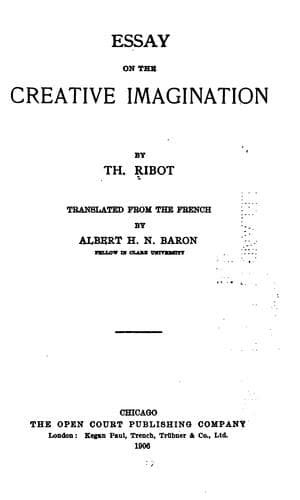
Essay on the Creative ImaginationRibot, Th. (Théodule)
Science
Essay on the Creative Imagination
Ribot, Th. (Théodule)
Creation (Literary, artistic, etc.); Imagination
2. But this first comparison does not go to the bottom of the matter;
there are yet deeper analogies. First, the completely subjective
character of both instances. The imagination is subjective, personal,
anthropocentric; its movement is from within outwards toward an
objectification. The understanding, i.e., the intellect in the
restricted sense, has opposite characteristics--it is objective,
impersonal, receives from outside. For the creative imagination the
inner world is the regulator; there is a preponderance of the inner over
the outer. For the understanding, the outside world is the regulator;
there is a preponderance of the outer over the inner. The world of my
imagination is _my_ world as opposed to the world of my understanding,
which is the world of all my fellow creatures. On the other hand, as
regards the will, we might repeat exactly, word for word, what we have
just said of the imagination. This is unnecessary. Back of both, then,
we have our true cause, whatever may be our opinion concerning the
ultimate nature of causation and of will.
3. Both imagination and will have a teleological character, and act only
with a view toward an end, being thus the opposite of the understanding,
which, as such, limits itself to proof. We are always wanting something,
be it worthless or important. We are always inventing for an
end--whether in the case of a Napoleon imagining a plan of campaign, or
a cook making up a new dish. In both instances there is now a simple end
attained by immediate means, now a complex and distant goal
presupposing subordinate ends which are means in relation to the final
end. In both cases there is a _vis a tergo_ designated by the vague term
"spontaneity," which we shall attempt to make clear later, and a _vis a
fronte_, an attracting movement.
4. Added to this analogy as regards their nature, there are other,
secondary likenesses between the abortive forms of the creative
imagination and the impotent forms of the will. In its normal and
complete form will culminates in an act; but with wavering characters
and sufferers from abulia deliberation never ends, or the resolution
remains inert, incapable of realization, of asserting itself in
practice. The creative imagination also, in its complete form, has a
tendency to become objectified, to assert itself in a work that shall
exist not only for the creator but for everybody. On the contrary, with
dreamers pure and simple, the imagination remains a vaguely sketched
inner affair; it is not embodied in any esthetic or practical invention.
Revery is the equivalent of weak desires; dreamers are the abulics of
the creative imagination.
Public-domain text, read in full here on John Shaqi.
Reviews
Reviews
No reviews yet
Be the first to share your thoughts on this work.
Join the Discussion
Join the discussion
Sign in to leave a comment or review.
Sign InorCreate an account