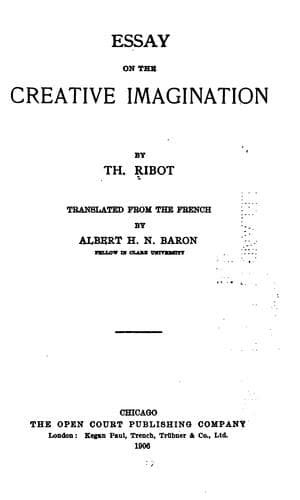
Essay on the Creative ImaginationRibot, Th. (Théodule)
Science
Essay on the Creative Imagination
Ribot, Th. (Théodule)
Creation (Literary, artistic, etc.); Imagination
It is unnecessary to add that the similarity established here between
the will and the imagination is only partial and has as its aim only to
bring to light the role of the motor elements. Surely no one will
confuse two aspects of our psychic life that are so distinct, and it
would be foolish to delay in order to enumerate the differences. The
characteristic of novelty should by itself suffice, since it is the
special and indispensable mark of invention, and for volition is only
accessory: The extraction of a tooth requires of the patient as much
effort the second time as the first, although it is no longer a novelty.
After these preliminary remarks we must go on to the analysis of the
creative imagination, in order to understand its nature in so far as
that is accessible with our existing means. It is, indeed, a tertiary
formation in mental life, if we assume a primary layer (sensations and
simple emotions), and a secondary (images and their associations,
certain elementary logical operations, etc.). Being composite, it may be
decomposed into its constituent elements, which we shall study under
these three headings, viz., the intellectual factor, the affective or
emotional factor, and the unconscious factor. But that is not enough;
the analysis should be completed by a synthesis. All imaginative
creation, great or small, is organic, requires a unifying principle:
there is then also a synthetic factor, which it will be necessary to
determine.
FOOTNOTES:
[1] A. Maury, in his book _L'Astronomie et la Magie_, enumerates
fifty cases.
[2] There are still others, as we shall see later on.
PART ONE
ANALYSIS OF THE IMAGINATION
CHAPTER I
THE INTELLECTUAL FACTOR.
I
Considered under its intellectual aspect, that is, in so far as it
borrows its elements from the understanding, the imagination presupposes
two fundamental operations--the one, negative and preparatory,
dissociation; the other, positive and constitutive, association.
Dissociation is the "abstraction" of the older psychologists, who well
understood its importance for the subject with which we are now
concerned. Nevertheless, the term "dissociation" seems to me preferable,
because it is more comprehensive. It designates a genus of which the
other is a species. It is a spontaneous operation and of a more radical
nature than the other. Abstraction, strictly so-called, acts only on
isolated states of consciousness; dissociation acts, further, on series
of states of consciousness, which it sorts out, breaks up, dissolves,
and through this preparatory work makes suitable for entering into new
combinations.
Public-domain text, read in full here on John Shaqi.
Reviews
Reviews
No reviews yet
Be the first to share your thoughts on this work.
Join the Discussion
Join the discussion
Sign in to leave a comment or review.
Sign InorCreate an account