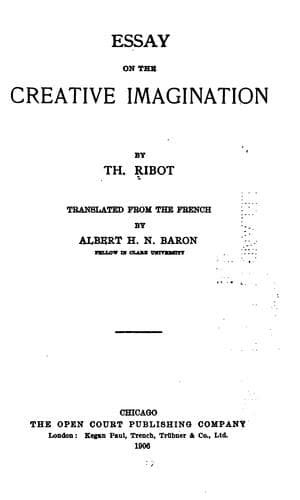
Essay on the Creative ImaginationRibot, Th. (Théodule)
Science
Essay on the Creative Imagination
Ribot, Th. (Théodule)
Creation (Literary, artistic, etc.); Imagination
FOOTNOTES:
[119] See above, Part One, chapter II.
[120] For a complete and recent study of the question, see A.
Lehmann, _Aberglaube und Zauberei von den aeltesten Zeiten bis in die
Gegenwart_, 1898.
[121] Lang, _op. cit._, I, 96. There will be found many other facts
of this kind.
[122] If this book were not merely an essay, we should have had to
study language as an instrument of the practical life in its
relations to the creative imagination, especially the function of
analogy, in the extension and transformation of the meanings of
words. Works on linguistics are full of evidence on this point. One
could do better still by attending exclusively to the vernacular, to
slang, which shows us creative force in action. "Slang," says one
philologist, "has the property of figuring, expressing, and
picturing language.... With it, however low its origin, one could
reconstruct a people or a society." Its principal, not only, means,
are metaphor and allegory. It lends itself equally to methods that
degrade or ennoble existing words, but with a very marked preference
for the worse or degrading meanings.
[123] Ample information on this point will be found in the work of
Espinas, _Les Origines de la Technologie_.
[124] The same correspondent, without my having asked him in regard
to this, gives me the following details: "When about seven years old
I saw a locomotive, its fire and smoke. My father's stove also made
fire and smoke, but lacked wheels. If, then, I told my father, we
put wheels under the stove, it would move like a locomotive. Later,
when about thirteen, the sight of a steam threshing-machine
suggested to me the idea of making a horseless wagon. I began a
childish construction of one, which my father made me give up," etc.
The tendency toward mechanical invention shows itself very early in
some children--we gave examples of it before. Our inventor adds: "My
imagination was strongest at about the age of 25 to 35 (I am now 45
years old). After that time it seems to me that the remainder of
life is good only for producing less important conceptions, forming
a natural consequence of the principal conceptions born of the
period of youth."
[125] See above, Part Two, chapter V.
[126] L. Bourdeau, _Les Forces de l'Industrie_, Paris, 1884. This
very substantial work, abounding in facts, conceived after a
systematic plan, has aided us much in this study.
[127] _Op. cit._, pp. 45-46.
[128] Quoted by L. Bourdeau (_op. cit._, p. 354), who also mentions
many other attempts: an anonymous Scot in 1753, Lesage of Geneva,
1780, Lhomond (France, 1787), Battencourt (Spain, 1787), Reiser, a
German (1794), Salva (Madrid, 1796). The insufficient study of
dynamic electricity did not permit them to succeed.
[129] E. Veron, _L'Esthetique_, p. 315.
[130] L. Bourdeau, _op. cit._, p. 233.
CHAPTER VI
THE COMMERCIAL IMAGINATION
Public-domain text, read in full here on John Shaqi.
Reviews
Reviews
No reviews yet
Be the first to share your thoughts on this work.
Elsewhere in the archive
Join the Discussion
Join the discussion
Sign in to leave a comment or review.
Sign InorCreate an account