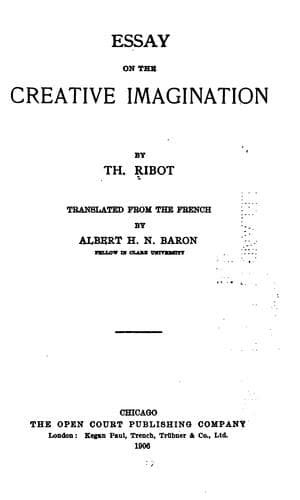
Essay on the Creative ImaginationRibot, Th. (Théodule)
Science
Essay on the Creative Imagination
Ribot, Th. (Théodule)
Creation (Literary, artistic, etc.); Imagination
Taking the word "commercial" in its broadest signification, I understand
by this expression all those forms of the constructive imagination that
have for their chief aim the production and distribution of wealth, all
inventions making for individual or collective enrichment. Even less
studied than the form preceding, this imaginative manifestation reveals
as much ingenuity as any other. The human mind is largely busied in that
way. There are inventors of all kinds--the great among these equal those
whom general opinion ranks as highest. Here, as elsewhere, the great
body invent nothing, live according to tradition, in routine and
imitation.
Invention in the commercial or financial field is subject to various
conditions with which we are not concerned:
(1) External conditions:--Geographical, political, economic, social,
etc., varying according to time, place, and people. Such is its external
determinism--human and social here in place of cosmic, physical, as in
mechanical invention.
(2) Internal, psychological conditions, most of which are foreign to the
primary and essential inventive act:--on one hand, foresight,
calculation, strength of reasoning;--in a word, capacity for reflection;
on the other hand, assurance, recklessness, soaring into the unknown--in
a word, strong capacity for action. Whence arise, if we leave out the
mixed forms, two principal types--the calculating, the venturesome. In
the former the rational element is first. They are cautious,
calculating, selfish exploiters, with no great moral or social
preoccupations. In the latter, the active and emotional element
predominates. They have a broader sweep. Of this sort were the
merchant-sailors of Tyre, Carthage, and Greece; the merchant-travelers
of the Middle Ages, the mercantile and gain-hungry explorers of the
fifteenth, sixteenth, and seventeenth centuries; later, in a changed
form, the organizers of great companies, the inventors of monopolies,
American "trusts," etc. These are the great imaginative minds.
Eliminating, then, from our subject, what is not the purely imaginative
element in order to study it alone, I see only two points for us to
treat, if we would avoid repetition--at the initial moment of invention,
the intuitive act that is its germ; during the period of development and
organization, the necessary and exclusive role of schematic images.
I
Public-domain text, read in full here on John Shaqi.
Reviews
Reviews
No reviews yet
Be the first to share your thoughts on this work.
Elsewhere in the archive
Join the Discussion
Join the discussion
Sign in to leave a comment or review.
Sign InorCreate an account