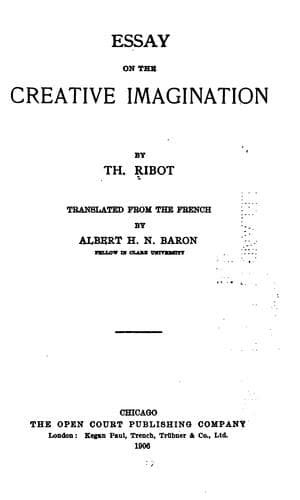
Essay on the Creative ImaginationRibot, Th. (Théodule)
Science
Essay on the Creative Imagination
Ribot, Th. (Théodule)
Creation (Literary, artistic, etc.); Imagination
Man is able to create for two principal reasons. The first, motor in
nature, is found in the action of his needs, appetites, tendencies,
desires. The second is the possibility of a spontaneous revival of
images that become grouped in new combination.
1. We have already shown in detail[146] that the hypothesis of a
"creative instinct," if the expression is used not as an abbreviated or
metaphorical formula but in the strict sense, is a pure chimera, an
empty entity. In studying the various types of imagination we have
always been careful to note that every mode of creation may be reduced,
as regards its beginnings, to a tendency, a want, a special, determinate
desire. Let us recall for the last time these initial conditions of all
invention--these desires, conscious or not, that excite it.
The wants, tendencies, desires--it matters not which term we adopt--the
whole of which constitutes the instinct of individual preservation, have
been the generators of all inventions dealing with food-getting,
housing, making of weapons, instruments, and machines.
The need for individual and social expansion or extension has given rise
to military, commercial, and industrial invention, and in its
disinterested form, esthetic creation.
As for the sexual instinct, its psychic fertility is in no way less than
the physical--it is an inexhaustible source of imagination in everyday
life as well as in art.
The wants of man in contact with his fellows have engendered, through
instinctive or reflective action, the numerous social and practical
creations regulating human groups, and they are rough or complex, stable
or unstable, just or unjust, kindly or harsh.
The need of knowing and of explaining, well or ill, has created myths,
religions, philosophical systems, scientific hypotheses.
Every want, tendency or desire may, then, become creative, by itself or
associated with others, and into these final elements it is that
analysis must resolve "creative spontaneity." This vague expression
corresponds to a _sum_, not to a special property.[147] Every invention,
then, has a _motor_ origin; _the ultimate basis of the constructive
imagination is motor_.
2. But needs and desires by themselves cannot create--they are only a
stimulus and a spring. Whence arises the need of a second condition--the
spontaneous revival of images.
Public-domain text, read in full here on John Shaqi.
Reviews
Reviews
No reviews yet
Be the first to share your thoughts on this work.
Elsewhere in the archive
Join the Discussion
Join the discussion
Sign in to leave a comment or review.
Sign InorCreate an account