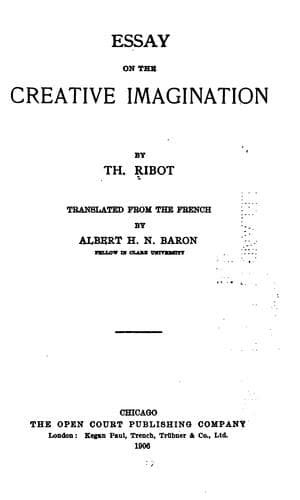
Essay on the Creative ImaginationRibot, Th. (Théodule)
Science
Essay on the Creative Imagination
Ribot, Th. (Théodule)
Creation (Literary, artistic, etc.); Imagination
[151] Sante de Santis, _I Sogni_, chapter X; Dr. Tissie, _Les
Reves_, esp. p. 165, the case of a merchant who dreams of having
paid a certain debt, and several weeks afterward meets his creditor,
and maintains that they are even, giving way only to proof.
[152] For the complete account, see his _Pathologie des emotions_,
pp. 345-49. (Paris, F. Alcan.)
[153] Dr. Max Simon, in an article on "Imagination in Insanity"
(_Annales medico-psychologiques_, December, 1876), holds that every
kind of mental disease has its own form of imagination that
expresses itself in stories, compositions, sketches, decorations,
dress, and symbolic attributes. The maniac invents complicated and
improbable designs; the persecuted, symbolic designs, strange
writings, bordering on the horrible; megalomaniacs look for the
effect of everything they say and do; the general paralytic lives in
grandeur and attributes capital importance to everything; lunatics
love the naive and childishly wonderful.
There are also great imaginers who, having passed through a period
of insanity, have strongly regretted it "as a state in which the
soul, more exalted and more refined, perceives invisible relations
and enjoys spectacles that escape the material eyes." Such was
Gerard de Nerval. As for Charles Lamb, he would assert that he
should be envied the days spent in an insane asylum. "Sometimes," he
said in a letter to Coleridge, "I cast a longing glance backwards to
the condition in which I found myself; for while it lasted I had
many hours of pure happiness. Do not believe, Coleridge, that you
have tasted the grandeur and all the transport of fancy if you have
not been insane. Everything seems to me now insipid in comparison."
Quoted by A. Barine, _Nevroses_, p. 326.
[154] There has often been cited the instance of certain maniacs at
Charenton, who, during the Franco-Prussian War, despite the stories
that were told them, the papers that they read, and the shells
bursting under the walls of the asylum, maintained that the war was
only imagined, and that all was only a contrivance of their
persecutors.
APPENDICES
APPENDIX A
THE VARIOUS FORMS OF INSPIRATION[155]
Among the descriptions of the inspired state found in various authors, I
select only three, which are brief and have each a special character.
I. Mystic inspiration, in a passive form, in Jacob Boehme (_Aurora_): "I
declare before God that I do not myself know how the thing arises within
me, without the participation of my will. I do not even know that which
I must write. If I write, it is because the Spirit moves me and
communicates to me a great, wonderful knowledge. Often I do not even
know whether I dwell in spirit in this present world and whether it is I
myself that have the fortune to possess a certain and solid knowledge."
Public-domain text, read in full here on John Shaqi.
Reviews
Reviews
No reviews yet
Be the first to share your thoughts on this work.
Elsewhere in the archive
Join the Discussion
Join the discussion
Sign in to leave a comment or review.
Sign InorCreate an account