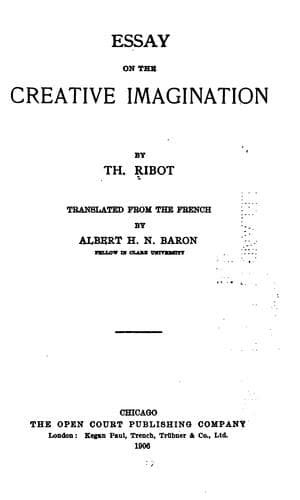
Essay on the Creative ImaginationRibot, Th. (Théodule)
Science
Essay on the Creative Imagination
Ribot, Th. (Théodule)
Creation (Literary, artistic, etc.); Imagination
II. Feverish and painful inspiration in Alfred de Musset: "Invention
annoys me and makes me tremble. Execution, always too slow for my wish,
makes my heart beat awfully, and weeping, and keeping myself from crying
aloud, I am delivered of an idea that is intoxicating me, but of which
I am mortally ashamed and disgusted next morning. If I change it, it is
worse, it deserts me--it is much better to forget it and wait for
another; but this other comes to me so confused and misshapen that my
poor being cannot contain it. It presses and tortures me, until it has
taken realizable proportions, when comes the other pain, of bringing
forth, a truly physical suffering that I cannot define. And that is how
my life is spent when I let myself be dominated by this artistic monster
in me. It is much better, then, that I should live as I have imagined
living, that I go to all kinds of excess, and that I kill this
never-dying worm that people like me modestly term their inspiration,
but which I call, plainly, my weakness."[156]
III. The poet Grillparzer[157] analyzes the condition, thus:
"Inspiration, properly so called, is the concentration of all the
faculties and aptitudes on a single point which, for the moment, should
include the rest of the world less than represent it. The strengthening
of the state of the soul comes from the fact that its various faculties,
instead of being disseminated over the whole world, find themselves
contained within the limits of a single object, touch one another,
reciprocally upholding, reenforcing, completing themselves. Thanks to
this isolation, the object emerges out of the average level of its
_milieu_, is illumined all around and put in relief--it takes body,
moves, lives. But to attain this is necessary the concentration of all
the faculties. It is only when the art-work has been a world for the
artist that it is also a world for others."
FOOTNOTES:
[155] See Part One, chapter III.
[156] George Sand, _Elle et Lui_, I.
[157] In Oelzelt-Newin, _op. cit._, p. 49.
APPENDIX B
ON THE NATURE OF THE UNCONSCIOUS FACTOR
We have seen that in the question of the unconscious there
must be recognized a positive part--facts, and an hypothetical
part--theories.[158]
Public-domain text, read in full here on John Shaqi.
Reviews
Reviews
No reviews yet
Be the first to share your thoughts on this work.
Elsewhere in the archive
Join the Discussion
Join the discussion
Sign in to leave a comment or review.
Sign InorCreate an account