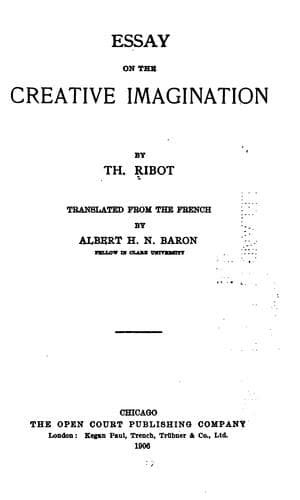
Essay on the Creative ImaginationRibot, Th. (Théodule)
Science
Essay on the Creative Imagination
Ribot, Th. (Théodule)
Creation (Literary, artistic, etc.); Imagination
I have questioned a very great number of imaginative persons, well known
to me as such, and have chosen preferably those who, not making a
profession of creating, let their fancy wander as it wills, without
professional care. In all the mechanism is the same, differing scarcely
more than temperament and degree of culture. Here are two examples.
B......, forty-six years of age, is acquainted with a large part of
Europe, North America, Oceania, Hindoostan, Indo-China, and North
Africa, and has not passed through these countries on the run, but,
because of his duties, resided there some time. It is worthy of remark,
as will be seen from the following observation, that the remembrance of
such various countries does not have first place in this brilliant,
fanciful personage--which fact is an argument in favor of the very
personal character of the creative imagination.
"In a general way, imagination, very lively in me, functions by
association of ideas. Memory or the outer world furnishes me some data.
On this data there is not always, though there should be, imaginative
work proper, and then things remain as they are, without end.
"But when I meet a construction--it matters little whether ancient or in
the course of erection--the formula, 'That ought to be fixed,' is one
that rises mechanically to my mind in such a case; often it happens that
I think aloud and say it, although alone. When going away from the
architectural subject[168] under consideration, I make up infinite
variations upon it, one after another. Sometimes the things start from a
reflex...."
After having noted his preference for the architecture of the Middle
Ages, B...... adds (here he touches on the unconscious factor):
"Were I to explain or attempt to explain how the Middle Ages have such
an attraction for my mind, I should see therein an atavistic
accumulation of religious feeling fixed in my family, on the female side
no doubt, and of religiousness in ecclesiastical architecture--these
touch.
"Another example illustrating the role of association of ideas in the
same matter. One Sunday night I left Noumea in the carriage of Dr.
F...... who was going to visit a nunnery five leagues from there. At the
moment of our arrival the doctor asked what time it was. 'Half-past
two,' I said, looking at my watch. As we stopped in the convent court
in front of the chapel I _heard_ the lusty conclusion of a psalm. 'They
are singing vespers,' I remarked to the doctor. He commenced to laugh.
'What time are vespers sung in your town?' 'At half-past two,' I
answered. I opened the chapel door in order to show the doctor that
vespers had just been held: the chapel was vacant. As I stood there,
somewhat non-plussed, the doctor remarked, 'Cerebral automatism.'
Public-domain text, read in full here on John Shaqi.
Reviews
Reviews
No reviews yet
Be the first to share your thoughts on this work.
Elsewhere in the archive
Join the Discussion
Join the discussion
Sign in to leave a comment or review.
Sign InorCreate an account