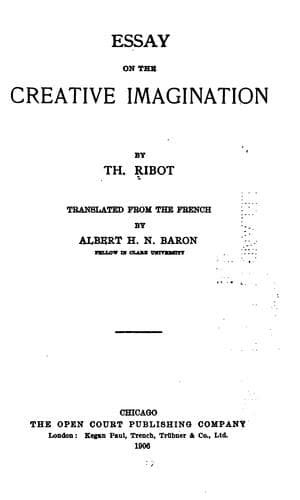
Essay on the Creative ImaginationRibot, Th. (Théodule)
Science
Essay on the Creative Imagination
Ribot, Th. (Théodule)
Creation (Literary, artistic, etc.); Imagination
The present work is offered to the reader as an essay or first attempt
only. It is not our intention here to undertake a complete monograph
that would require a thick volume, but only to seek the underlying
conditions of the creative imagination, showing that it has its
beginning and principal source in the natural tendency of images to
become objectified (or, more simply, in the motor elements inherent in
the image), and then following it in its development under its manifold
forms, whatever they may be. For I cannot but maintain that, at present,
the psychology of the imagination is concerned almost wholly with its
part in esthetic creation and in the sciences. We scarcely get beyond
that; its other manifestations have been occasionally mentioned--never
investigated. Yet invention in the fine arts and in the sciences is only
a special case, and possibly not the principal one. We hope to show that
in practical life, in mechanical, military, industrial, and commercial
inventions, in religious, social, and political institutions, the human
mind has expended and made permanent as much imagination as in all other
fields.
The constructive imagination is a faculty that in the course of ages has
undergone a reduction--or at least, some profound changes. So, for
reasons indicated later on, the mythic activity has been taken in this
work as the central point of our topic, as the primitive and typical
form out of which the greater number of the others have arisen. The
creative power is there shown entirely unconfined, freed from all
hindrance, careless of the possible and the impossible; in a pure state,
unadulterated by the opposing influence of imitation, of ratiocination,
of the knowledge of natural laws and their uniformity.
In the first or analytical part, we shall try to resolve the
constructive imagination into its constitutive factors, and study each
of them singly.
The second or genetic part will follow the imagination in its
development as a whole from the dimmest to the most complex forms.
Finally, the third or concrete part, will be no longer devoted to the
imagination, but to imaginative beings, to the principal types of
imagination that observation shows us.
May, 1900.
ANALYTICAL TABLE OF CONTENTS.
PAGE
Translator's Preface v
Author's Preface vii
INTRODUCTION.
THE MOTOR NATURE OF THE CONSTRUCTIVE IMAGINATION.
Public-domain text, read in full here on John Shaqi.
Reviews
Reviews
No reviews yet
Be the first to share your thoughts on this work.
Join the Discussion
Join the discussion
Sign in to leave a comment or review.
Sign InorCreate an account