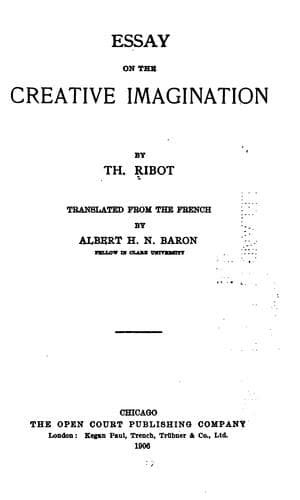
Essay on the Creative ImaginationRibot, Th. (Théodule)
Science
Essay on the Creative Imagination
Ribot, Th. (Théodule)
Creation (Literary, artistic, etc.); Imagination
Transition from the reproductive to the creative
imagination.--Do all representations contain motor
elements?--Unusual effects produced by images: vesication,
stigmata; their conditions; their meaning for our
subject.--The imagination is, on the intellectual side,
equivalent to will. Proof: Identity of development;
subjective, personal character of both; teleologic
character; analogy between the abortive forms of the
imagination and abulias. 3
FIRST PART.
ANALYSIS OF THE IMAGINATION.
CHAPTER I.
THE INTELLECTUAL FACTOR.
Dissociation, preparatory work.--Dissociation in complete,
incomplete and schematic images.--Dissociation in series.
Its principal causes: internal or subjective, external or
objective.--Association: its role reduced to a single
question, the formation of new combinations.--The principal
intellectual factor is thinking by analogy. Why it is an
almost inexhaustible source of creation. Its mechanism. Its
processes reducible to two, viz.: personification,
transformation. 15
CHAPTER II.
THE EMOTIONAL FACTOR.
The great importance of this element.--All forms of the
creative imagination imply affective elements. Proofs: All
affective conditions may influence the imagination. Proofs:
Association of ideas on an emotional basis; new combinations
under ordinary and extraordinary forms.--Association by
contrast.--The motor element in tendencies.--There is no
creative instinct; invention has not _a_ source, but
_sources_, and always arises from a need.--The work of the
imagination reduced to two great classes, themselves
reducible to special needs.--Reasons for the prejudice in
favor of a creative instinct. 31
CHAPTER III.
THE UNCONSCIOUS FACTOR.
Various views of the "inspired state." Its essential
characteristics; suddenness, impersonality.--Its relations
to unconscious activity.--Resemblances to hypermnesia, the
initial state of alcoholic intoxication and somnambulism on
waking.--Disagreements concerning the ultimate nature of
unconsciousness: two hypotheses.--The "inspired state" is
not a cause, but an index.--Associations in unconscious
form.--Mediate or latent association: recent experiments and
discussions on this subject.--"Constellation" the result of
a summation of predominant tendencies. Its mechanism. 50
CHAPTER IV.
THE ORGANIC CONDITIONS OF THE IMAGINATION.
Public-domain text, read in full here on John Shaqi.
Reviews
Reviews
No reviews yet
Be the first to share your thoughts on this work.
Join the Discussion
Join the discussion
Sign in to leave a comment or review.
Sign InorCreate an account