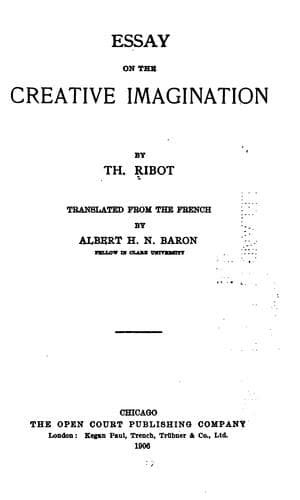
Essay on the Creative ImaginationRibot, Th. (Théodule)
Science
Essay on the Creative Imagination
Ribot, Th. (Théodule)
Creation (Literary, artistic, etc.); Imagination
Let us now consider the class of esthetic creations. According to the
generally accepted theory which is too well known for me to stop to
explain it, art has its beginning in a superfluous, bounding activity,
useless as regards the preservation of the individual, which is shown
first in the form of play. Then, through transformation and
complication, play becomes primitive art, dancing, music, and poetry at
the same time, closely united in an apparently indissoluble unity.
Although the theory of the absolute inutility of art has met some strong
criticism, let us accept it for the present. Aside from the true or
false character of inutility, the psychological mechanism remains the
same here as in the preceding cases; we shall only say that in place of
a vital need it is a need of _luxury_ acting, but it acts only because
it is in man.
Nevertheless, the inutility of play is far from proven biologically.
Groos, in his two excellent works on the subject,[17] has maintained
with much power the opposite view. According to him the theory of
Schiller and Spencer, based on the expenditure of superfluous activity
and the opposite theory of Lazarus, who reduces play to a
relaxation--that is, a recuperation of strength--are but partial
explanations. Play has a positive use. In man there exist a great number
of instincts that are not yet developed at birth. An incomplete being,
he must have education of his capacities, and this is obtained through
play, _which is the exercise of the natural tendencies of human
activities_. In man and in the higher animals plays are a preparation, a
prelude to the active functions of life. _There is no instinct of play
in general, but there are special instincts that are manifested under
the forms of play._ If we admit this explanation, which does not lack
potency, the work of the esthetic imagination itself would be reduced
to a biological necessity, and there would be no reason for making a
separate category of it. Whichever view we may adopt, it still remains
established that any invention is reducible, directly or indirectly, to
a particular, determinate need, and that to allow man a special
instinct, the definite specific character of which should be stimulation
to creative activity, is a fantastic notion.
Public-domain text, read in full here on John Shaqi.
Reviews
Reviews
No reviews yet
Be the first to share your thoughts on this work.
Join the Discussion
Join the discussion
Sign in to leave a comment or review.
Sign InorCreate an account