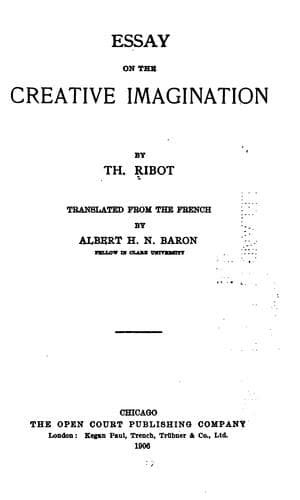
Essay on the Creative ImaginationRibot, Th. (Théodule)
Science
Essay on the Creative Imagination
Ribot, Th. (Théodule)
Creation (Literary, artistic, etc.); Imagination
Whence, then, comes this persistent and in some respects seductive idea
that creation is an instinctive result? Because a happy invention has
characteristics that evidently relate it to instinctive activity in the
strict sense of the word. First, precocity, of which we shall later give
numerous examples, and which resembles the innateness of instinct.
Again, orientation in a single direction: the inventor is, so to speak,
polarized; he is the slave of music, of mechanics, of mathematics; often
inapt at everything outside his own particular sphere. We know the
witticism of Madame du Deffant on Vaucanson, who was so awkward, so
insignificant when he ventured outside of mechanics. "One should say
that this man had manufactured himself." Finally, the ease with which
invention often (not always) manifests itself makes it resemble the work
of a pre-established mechanism.
But these and similar characteristics may be lacking. They are necessary
for instinct, not for invention. There are great creators who have been
neither precocious nor confined in a narrow field, and who have given
birth to their inventions painfully, laboriously. Between the mechanism
of instinct and that of imaginative creation there are frequently great
analogies but not identity of nature. Every tendency of our
organization, useful or hurtful, may become the beginning of a creative
act. Every invention arises from a particular need of human nature,
acting within its own sphere and for its own special end.
If now it should be asked why the creative imagination directs itself
preferably in one line rather than in another--toward poetry or physics,
trade or mechanics, geometry or painting, strategy or music, etc.--we
have nothing in answer. It is a result of the individual organization,
the secret of which we do not possess. In ordinary life we meet people
visibly borne along toward love or good cheer, toward ambition, riches
or good works; we say that they are "so built," that such is their
character. At bottom the two questions are identical, and current
psychology is not in a position to solve them.
FOOTNOTES:
[12] _Ueber Phantasievorstellungen_, Graz, 1889, p. 48.
[13] _Die Spiele der Thiere_, Jena, 1896. The subject has been very
well treated by this author, pp. 294-301.
[14] The "disinterested" view is found widely advocated or hinted at
in literature. Cf. Goethe's "Der Saenger" (Tr.).
[15] _Psychology_, I, 571 ff.
[16] Hoeffding, _Psychologie_, p. 219; _Eng. trans._, p. 161.
[17] Groos, _Die Spiele der Thiere_, 1896, and _Die Spiele der
Menschen_, 1899 (Eng. trans., Appletons, New York, 1898, 1901).
CHAPTER III
THE UNCONSCIOUS FACTOR
I
Public-domain text, read in full here on John Shaqi.
Reviews
Reviews
No reviews yet
Be the first to share your thoughts on this work.
Join the Discussion
Join the discussion
Sign in to leave a comment or review.
Sign InorCreate an account