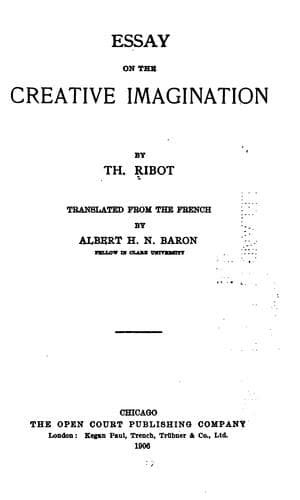
Essay on the Creative ImaginationRibot, Th. (Théodule)
Science
Essay on the Creative Imagination
Ribot, Th. (Théodule)
Creation (Literary, artistic, etc.); Imagination
By this term I designate principally, not exclusively, what ordinary
speech calls "inspiration." In spite of its mysterious and
semi-mythological appearance, the term indicates a positive fact, one
that is ill-understood in a deep sense, like all that is near the roots
of creation. This concept has its history, and if it is permissible to
apply a very general formula to a particular case we may say that it has
developed according to the law of the three states assumed by the
positivists.
In the beginning, inspiration is literally ascribed to the
gods--among the Greeks to Apollo and the Muses, and in like manner
under various polytheistic religions. Later, the gods become
supernatural spirits, angels, saints, etc. In one way or another it
is always regarded as external and superior to man. In the
beginnings of all inventions--agriculture, navigation, medicine,
commerce, legislation, fine arts--there is a belief in revelation;
the human mind considers itself incapable of having discovered all
that. Creation has arisen, we do not know how, in a total ignorance
of the processes.
Later on these higher beings become empty formulas, mere survivals;
there remain only the poets to invoke their aid, through the force of
tradition, without believing in them. But side by side with these formal
survivals there remains a mysterious ground which is translated by vague
expressions and metaphors, such as "enthusiasm," "poetic frenzy,"
"possession by a spirit," "being overcome," "having the devil inside
one," "the spirit whispers as it lists," etc. Here we have come out of
the supernatural without, however, attempting a positive (i.e., a
scientific) explanation.
Lastly, in the third stage, we try to sound this unknown. Psychology
sees in it a special manifestation of the mind, a particular,
semi-conscious, semi-unconscious state which we must now study.
At first sight, and considered in its negative aspect, inspiration
presents a very definite character. It does not depend on the individual
will. As in the case of sleep or digestion, we may try to call it forth,
encourage it, maintain it; but not always with success. Inventors, great
and small, never cease to complain over the periods of unproductiveness
which they undergo in spite of themselves. The wiser among them watch
for the moment; the others attempt to fight against their evil fate and
to create despite nature.
Considered in its positive aspect, inspiration has two essential
marks--suddenness and impersonality.
Public-domain text, read in full here on John Shaqi.
Reviews
Reviews
No reviews yet
Be the first to share your thoughts on this work.
Join the Discussion
Join the discussion
Sign in to leave a comment or review.
Sign InorCreate an account