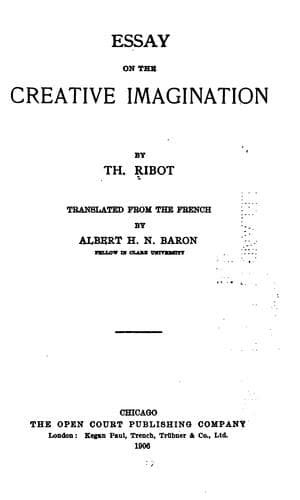
Essay on the Creative ImaginationRibot, Th. (Théodule)
Science
Essay on the Creative Imagination
Ribot, Th. (Théodule)
Creation (Literary, artistic, etc.); Imagination
The general fact of most importance consists of changes in the blood
circulation. Increase of intellectual activity means an increase of work
in the cortical cells, dependent on a congested, sometimes a temporarily
anaemic state. Hyperaemia seems rather the rule, but we also know that
slight anaemia increases cortical excitability. "Weak, contracted pulse;
pale, chilly skin; overheated head; brilliant, sunken, roving eyes,"
such is the classic, frequently quoted description of the physiological
state during creative labor. There are numerous inventors who, of their
own accord, have noted these changes--irregular pulse, in the case of
Lagrange; congestion of the head, in Beethoven, who made use of cold
douches to relieve it, etc. This elevation of the vital tone, this
nervous tension, translates itself also into motor form through
movements analogous to reflexes, without special end, mechanically
repeated and always the same in the same man--e.g., movement of the
feet, hands, fingers; whittling the table or the arms of a chair (as in
the case of Napoleon when he was elaborating a plan of campaign), etc.
It is a safety-valve for the excessive flow of nervous impulse, and it
is admitted that this method of expenditure is not useless for
preserving the understanding in all its clearness. In a word, increase
of the cerebral circulation is the formula covering the majority of
observations on this subject.
Does experimentation, strictly so called, teach us anything on this
point? Numerous and well-known physiological researches, especially
those of Mosso, show that all intellectual, and, most of all, emotional,
work, produces cerebral congestion; that the brain-volume increases, and
the volume of the peripheral organs diminishes. But that tells us
nothing particularly about the imagination, which is but a special case
under the rule. Latterly, indeed, it has been proposed to study
inventors by an objective method through the examination of their
several circulatory, respiratory, digestive apparatus; their general
and special sensibility; the modes of their memory and forms of
association, their intellectual processes, etc. But up to this time no
conclusion has been drawn from these individual descriptions that would
allow any generalization. Besides, has an experiment, in the strict
sense of the word, ever been made at the "psychological moment"? I know
of none. Would it be possible? Let us admit that by some happy chance
the experimenter, using all his means of investigation, can have the
subject under his hand at the exact moment of inspiration--of the
sudden, fertile, brief creative impulse--would not the experiment itself
be a disturbing cause, so that the result would be _ipso facto_
vitiated, or at least unconvincing?
Public-domain text, read in full here on John Shaqi.
Reviews
Reviews
No reviews yet
Be the first to share your thoughts on this work.
Join the Discussion
Join the discussion
Sign in to leave a comment or review.
Sign InorCreate an account