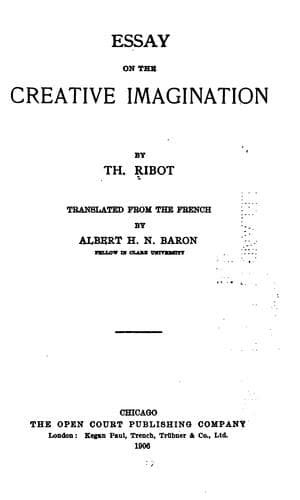
Essay on the Creative ImaginationRibot, Th. (Théodule)
Science
Essay on the Creative Imagination
Ribot, Th. (Théodule)
Creation (Literary, artistic, etc.); Imagination
Let us stick to experience. Physiology teaches that generation is a
"prolonged nutrition," a surplus, as we see so plainly in the lower
forms of agamous generation (budding, division). The creative
imagination likewise presupposes a superabundance of psychic life that
might otherwise spend itself in another way. Generation in the physical
order is a spontaneous, natural tendency, although it may be stimulated,
successfully or otherwise, by artificial means. We can say as much of
the other. This list of resemblances it would be easy to prolong. But
all this is insufficient for the establishment of a thorough identity
between the two cases and the solution of the question.
It is possible to limit it, to put it into more precise language. Is
there a connection between the development of the generative function
and that of the imagination? Even in this form the question scarcely
permits any but vague answers. In favor of a connection we may allege:
(1) The well-known influence of puberty on the imagination of both
sexes, expressing itself in day-dreams, in aspirations toward an
unattainable ideal,[28] in the genius for invention that love bestows
upon the least favored. Let us recall also the mental troubles, the
psychoses designated by the name hebephrenia. With adolescence coincides
the first flowering of the fancy which, having emerged from its
swaddling-clothes of childhood, is not yet sophisticated and
rationalized.
It is not a matter of indifference for the general thesis of the present
work to note that this development of the imagination depends wholly on
the first effervescence of the emotional life. That "influence of the
feelings on the imagination" and of "the imagination on the feelings" of
which the moralists and the older psychologists speak so often is a
vague formula for expressing this fact--that the motor element included
in the images is reinforced.
(2) _Per contra_, the weakening of the generative power and of the
constructive imagination coincide in old age, which is, in a word, a
decay of nutrition, a progressive atrophy. It is proper not to omit the
influence of castration. According to the theory of Brown-Sequard, it
produces an abatement of the nutritive functions through the suppression
of an internal stimulus; and, although its relations to the imagination
have not been especially studied, it is not rash to admit that it is an
arresting cause.
Public-domain text, read in full here on John Shaqi.
Reviews
Reviews
No reviews yet
Be the first to share your thoughts on this work.
Join the Discussion
Join the discussion
Sign in to leave a comment or review.
Sign InorCreate an account