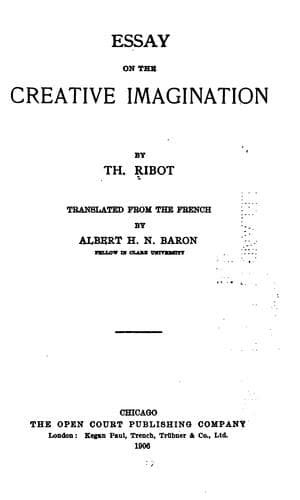
Essay on the Creative ImaginationRibot, Th. (Théodule)
Science
Essay on the Creative Imagination
Ribot, Th. (Théodule)
Creation (Literary, artistic, etc.); Imagination
Summing up: The organic bases of the creative imagination, if there are
any specially its own, remain to be determined. For in all that has been
said we have been concerned only with some conditions of the general
working of the mind--assimilation as well as invention. The
eccentricities of inventors studied carefully and in a detailed manner
would finally, perhaps, be most instructive material, because it would
allow us to penetrate into their inmost individuality. Thus, the
physiology of the imagination quickly becomes pathology. I shall not
dwell on this, having purposely eliminated the morbid side of our
subject. It will, however, be necessary to return thereto, touching upon
it in another part of this essay.
III
There remains a problem, so obscure and enigmatic that I scarcely
venture to approach it, in the analogy that most languages--the
spontaneous expression of a common thought--establish between
physiologic and psychic creation. Is it only a superficial likeness, a
hasty judgment, a metaphor, or does it rest on some positive basis?
Generally, the various manifestations of mental activity have as their
precursor an unconscious form from which they arise. The sensitiveness
belonging to living substance, known by the names heliotropism,
chemotropism, etc., is like a sketch of sensation and of the reactions
following it; organic memory is the basis and the obliterated form of
conscious memory. Reflexes introduce voluntary activity; appetitions and
hidden tendencies are the forerunners of effective psychology. Instinct,
on several sides, is like an unconscious and specific trial of reason.
Has the creative power of the human mind also analogous antecedents, a
physiological equivalent?
One metaphysician, Froschammer, who has elevated the creative
imagination to the rank of primary world-principle, asserts this
positively. For him there is an objective or cosmic imagination working
in nature, producing the innumerable varieties of vegetable and animal
forms; transformed into subjective imagination it becomes in the human
brain the source of a new form of creation. "The very same principle
causes the living forms to appear--a sort of objective image--and the
subjective images, a kind of living form."[27] However ingenious and
attractive this philosophical theory may be, it is evidently of no
positive value for psychology.
Public-domain text, read in full here on John Shaqi.
Reviews
Reviews
No reviews yet
Be the first to share your thoughts on this work.
Join the Discussion
Join the discussion
Sign in to leave a comment or review.
Sign InorCreate an account