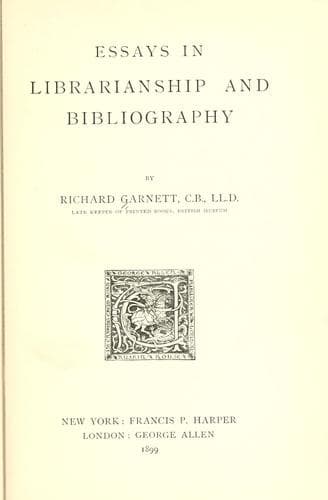
Essays in Librarianship and BibliographyGarnett, Richard
Science
Essays in Librarianship and Bibliography
Garnett, Richard
Bibliography -- Methodology; British Museum; Library science
enterprise must be kept distinct.
Another question of cataloguing which occupied the attention of the
Conference of 1877 was the important one of subject catalogues. In this
I am able to announce the most satisfactory progress. In the face of the
mass of information continually pouring in, the world has become alive
to the importance of condensing, distributing, and rendering generally
available the information which it possesses already. Three very
remarkable achievements of this kind may be noticed. The first is
Poole's Index to Periodicals, with its continuation, a work so
invaluable that we now wonder how we could have existed without it, but
so laborious that we could hardly have hoped to see it exist at all,
especially considering that it is an achievement of co-operative
cataloguing. In illustration of the want it supplies, I may mention that
it has been found necessary at the British Museum to reproduce the
preliminary tables by photography in a number of copies, the originals
having been worn to pieces. The next work I shall mention is the subject
index to the modern books acquired by the British Museum since 1880—two
bulky volumes, prepared in non-official time, with the greatest zeal and
devotion, by the superintendent of the Reading Room, Mr. Fortescue, and
continued by him to the present time. They are simply invaluable, and it
is only to be regretted that they have been issued at too high a price
to be generally available to the public. This is not the case with the
third publication which I have to mention—the classed catalogue issued
by Mr. Swan Sonnenschein, the utility of which is very generally known.
A cognate feature of the times is the great comparative attention now
paid to indexing, which is sometimes carried to lengths almost
ludicrous. The author of a work of information who does not give an
index is sure to be called over the coals, and with reason, for how else
is the reviewer to pick out the plums unless he actually reads the book?
I am not sure that this extreme facilitation of knowledge is in all
respects a good thing, but it is at present a necessary thing, and
correlated with that prevalence of abridged histories and biographies
which it is easy to criticise, but which has at least two good
points—the evidence it affords of the existence of a healthy appetite
for information among a large reading class, and the fact that
information is thus diffused among many to whom it would have been
inaccessible under other circumstances.
Public-domain text, read in full here on John Shaqi.
Reviews
Reviews
No reviews yet
Be the first to share your thoughts on this work.
Join the Discussion
Join the discussion
Sign in to leave a comment or review.
Sign InorCreate an account