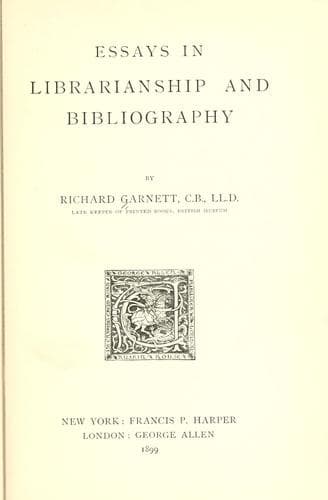
Essays in Librarianship and Bibliography — John Shaqi
Essays in Librarianship and BibliographyGarnett, Richard
Science
Essays in Librarianship and Bibliography
Garnett, Richard
Bibliography -- Methodology; British Museum; Library science
procure his book with the least possible delay, but also to present an
epitome of the life-work of every author, and to assist the researches
of the literary historian. Hence the explanation and justification of
some points which have on specious grounds been objected to in the
Museum Catalogue. It has been thought strange, for instance, that
anonymous books of which the authorship is known—such as the first
editions of the Waverley Novels—should not be entered under the names
of the authors. Two excellent reasons may be given: because by so
entering the book the character of the catalogue as a bibliographical
record would be destroyed; and because by entering one description of
anonymous books in one way and another in another, there would be an end
to the uniformity of rule which is necessary to prevent a very extensive
catalogue from getting into confusion. Another instance is the
cataloguing of academical transactions and periodicals under the
respective heads of Academies and Periodical Publications, which has
been much criticised. It is quite true that the _Quarterly Review_ can
be found more easily under that head than under "Periodical
Publications, London," but it is also true that the grouping of all
academical and all periodical publications under these two great heads
is invaluable to the bibliographer, the literary historian, and the
statistician, who must be exceedingly thankful that the information of
which they are in quest is presented to them in a concentrated form,
instead of having to be sought for through an enormous catalogue. These
observations do not in any way apply to libraries of an essentially
popular character, and I merely make them by way of enforcing the
proposition that the works of such libraries and those of national or
university libraries are different, and that we must beware of a
cast-iron uniformity of rule. There is yet another intermediate class of
library, the comparatively small but highly select, such as college and
club libraries, which will probably find it more advantageous to pursue
an intermediate course, as I imagine they do, judging from the very
excellent specimens of cataloguing for which we are indebted to some of
them. And there is yet another class, the libraries of the collectors
of exceedingly rare literatures, such as the Chatsworth Library, Mr.
Huth's, and Mr. Locker-Lampson's. In such catalogues minuteness of
bibliographical detail is rightly carried to an extent uncalled for in
great miscellaneous catalogues like that of the British Museum, and
which, it is to be hoped, may never be attempted there, for if it were
it would disorganise the establishment. It is not the business of
librarians as public servants to provide recondite bibliographical
luxuries. These things are excellent, but they lie in the department of
specialists and amateurs, who may be expected to cultivate it in the
future as they have done in the past. The limits of public and private
Public-domain text, read in full here on John Shaqi.
Reviews
Reviews
No reviews yet
Be the first to share your thoughts on this work.
Join the Discussion
Join the discussion
Sign in to leave a comment or review.
Sign InorCreate an account