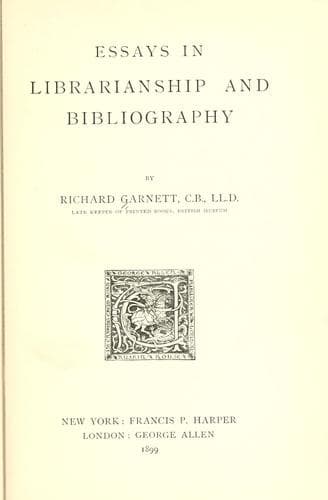
Essays in Librarianship and BibliographyGarnett, Richard
Science
Essays in Librarianship and Bibliography
Garnett, Richard
Bibliography -- Methodology; British Museum; Library science
commencing with 3000. With the new department 4000 commences, and the
same remark, _mutatis mutandis_, is applicable to every succeeding
principal division. I must pass very lightly over the numerous sections
of this second section. Beginning with the fundamental questions of the
being of a God and the truth of Christianity, it embraces every special
question which has formed the subject of discussion among Christians, in
the order which commended itself as most logical to the original
designer of the arrangement. These controversies conduct to the common
ground of Religious Devotion and Contemplation, including the important
departments of Tracts and Religious Fiction; and these to devotion in
its hortatory form—_i.e._, Sermons, classified on the same linguistic
principle as Scripture, and divided into the great sections of collected
discourses and separate sermons. With these the subject of specifically
Christian Theology terminates, and is succeeded by the great and
growing department of Mythology and non-Christian Religion. Judaism
follows, leading by an easy transition to Church History. A few words on
the arrangement of this section will save much repetition, as the
principle here exemplified is never departed from. It demonstrates the
advantage of beginning with a subject like the Bible, respecting the
correct arrangement of which there can be no dispute, and which serves
as a norm for all the rest. As the Bible necessarily commenced with
Polyglots, so Church History begins with General Church History; the
various nations succeed in their linguistic, which is practically also
their geographical order, provision being, of course, made for the
intercalation of sub-sections where necessary, as for instance one on
English Nonconformity. Polynesia, as the last member of this
arrangement, naturally introduces the next subject—Missions—which in
turn brings on Religious Orders, including Freemasonry. Religious
Biography follows, arranged on the same principle as Religious History,
which is always carried out wherever practicable. Finally, the whole
class is concluded by the small but important division of Religious
Bibliography.
Public-domain text, read in full here on John Shaqi.
Reviews
Reviews
No reviews yet
Be the first to share your thoughts on this work.
Elsewhere in the archive
Join the Discussion
Join the discussion
Sign in to leave a comment or review.
Sign InorCreate an account