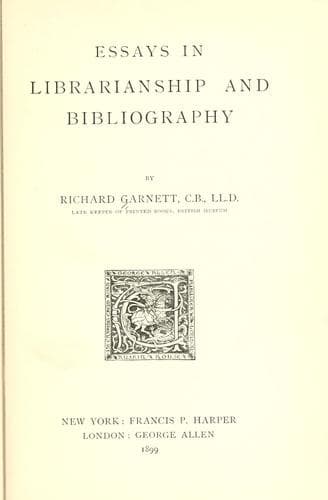
Essays in Librarianship and BibliographyGarnett, Richard
Science
Essays in Librarianship and Bibliography
Garnett, Richard
Bibliography -- Methodology; British Museum; Library science
Divine Law is evidently most fitly succeeded by Human Law, or
Jurisprudence. The fulness with which the preceding section has been
treated will enable me to pass very cursorily over this and its
successors. I may be pardoned, however, one remark suggested by the
introduction of a new division—that in the classification of a library
it should be considered whether the scope of the collection is special
or general. In arranging a mere collection of Law Books it would be
proper to commence with works treating of the general principles of
Jurisprudence. In arranging a great library, regard must be had to the
harmonious connection of the parts, and accordingly the Museum
arrangement commences with Ecclesiastical Law as the natural sequel of
Theology. Bulls, Councils, Canon-Law and Modern Church-Law introduce the
great section of Roman Law. Oriental Law follows, the Laws of the
Continental Nations succeed in the order previously explained, and thus
room is only found for General Jurisprudence at a comparatively late
period, at the beginning of the numeral series 6000. It brings after it
such minor subjects as Prison-Discipline and Forensic Medicine. The
remaining space of the section is occupied by the Law of the
English-speaking nations, which requires most minute subdivision.
Next to Divinity and Law, the third rank among the pursuits of the human
mind was anciently assigned to Medicine. We have learned to recognise
that Medicine, however practically important, ranks scientifically only
as a department of Biology. The next section, accordingly, commences
with general Natural History, continuing through the natural kingdoms of
Botany, Geology, and Zoology, including Veterinary Surgery, with their
appropriate subdivisions, and then embracing Medicine—first in its
general aspect, as medical principle and practice; then in its great
leading divisions of Physiology, Pathology, Therapeutics, &c.; again, as
Special Pathology; finally, in such comparative minutiæ as professional
controversies and bills of mortality. The divisions of Art—the next
class—are simple and obvious. They may be enumerated as Archæology,
Costumes, Numismatics, Architecture, Painting, Sculpture, first as
treated collectively, and then as treated separately; and, finally,
Music. Fine Art is succeeded by Useful Art, and the interval bridged
over by Field-Sports, Games of Chance, and Games of Skill. No
subdivision of the Useful Arts has been attempted beyond the separation
of Cookery and Domestic Economy from the rest, and the addition of two
special sections, one for the catalogues of industrial exhibitions, the
other for the voluminous and important publications of the South
Kensington Museum.
Public-domain text, read in full here on John Shaqi.
Reviews
Reviews
No reviews yet
Be the first to share your thoughts on this work.
Elsewhere in the archive
Join the Discussion
Join the discussion
Sign in to leave a comment or review.
Sign InorCreate an account