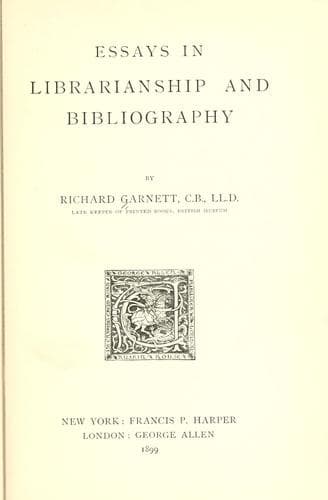
Essays in Librarianship and BibliographyGarnett, Richard
Science
Essays in Librarianship and Bibliography
Garnett, Richard
Bibliography -- Methodology; British Museum; Library science
The spread of a taste for bibliography is further illustrated by the
fact that an enterprising publisher has found it worth while to produce
a series of bibliographical manuals under the able editorship of Mr.
Alfred Pollard, and that these have amply repaid him. I may further
notice the recent appearance of two works of great importance to English
bibliography: Professor Arber's transcripts of the registers of the
Stationers' Company, now on the point of completion, and the supplement
to Allibone's Dictionary of English Authors. Two great advances in
library construction also call for a word of recognition; the
introduction of the sliding press at the British Museum, which
indefinitely adjourns the ever-pressing question of additional space
both in this and in every other library to which it can be adapted; and
the general employment of the electric light, which insures libraries
against the worst enemy of all. While touching on library construction,
I must briefly allude to a very remarkable recent publication, the
article "Bibliotheca" in the German Cyclopædia of Architecture. This
exhaustive disquisition is illustrated with a number of views of
libraries in all parts of the world; not merely of their plans and
elevations, their stately saloons and commodious reading rooms, but of
the most humble details of library furniture. It ought to be
translated.[27:1]
I have now to offer some concluding observations on the present
prospects of the library movement, as it affects our country and
ourselves. In both points of view there is, I think, much matter for
congratulation. We have progressed very decidedly since the period to
which I have been carrying you back in retrospect. As is often the case,
the foundation of this Association was both a symptom and a cause. It
indicated the existence of a feeling that libraries had not hitherto
occupied that position in public esteem which they ought to have; it
further powerfully contributed to secure this due position for them. I
think they are obtaining it. We cannot but be conscious of a wave of
public feeling slowly rising, the action of which is visible in the
establishment of new libraries, in the adoption of the Free Libraries
Act by communities which had long resisted it, in improved library
buildings and appliances, in acts of munificence like Mr. Carnegie's and
Mrs. Rylands's, and as a natural consequence, in the improved salaries
and status of librarians. I am aware that very much remains to be done
in this latter respect. No one can more earnestly desire that the
librarian's position were better than it is. It would not only be a boon
to the individual, but a sign full of hope for the community. We are
progressing, but we must progress much further. The key of the position
seems to me the restrictions imposed upon rates for library purposes.
If we could obtain more freedom for the ratepayers in this respect, and,
which would be much more difficult, persuade them to use it when they
Public-domain text, read in full here on John Shaqi.
Reviews
Reviews
No reviews yet
Be the first to share your thoughts on this work.
Join the Discussion
Join the discussion
Sign in to leave a comment or review.
Sign InorCreate an account