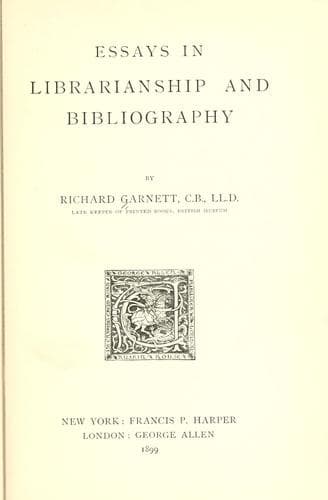
Essays in Librarianship and BibliographyGarnett, Richard
Science
Essays in Librarianship and Bibliography
Garnett, Richard
Bibliography -- Methodology; British Museum; Library science
had it, our free libraries might be in general what some of the more
favoured actually are. It is discouraging indeed to observe in a not
very wealthy community, when all necessary expenses have been met,
including the librarian's very inadequate salary, what a ridiculous
trifle remains for the acquisition of books.
There is only one way to obtain the desired end—to convince the public
that they are getting value for their money. The utility of the public
library must be visible to all men. It must be recognised as an
indispensable element of culture, and it must be shown, which is
unfortunately more difficult, that it is actually subserving this end,
not only for a few persons here and there, but for a considerable
proportion of the population. I am not opposing the admission of fiction
into public libraries, but it is evident that if fiction constitutes the
larger portion of the literature in request, the average ratepayer will
not think, nor ought he to think, that any case has been made out for
his inserting his hands more deeply into his pockets. I am quite aware,
of course, that librarians individually can do but little in this
direction. Whatever can be done should be done, for the entire case of
the librarian in claiming respect from the community and the material
advantages concatenated therewith is that he is, in however humble a
measure, a priest of literature and science; as truly, though not as
ostensibly, a public instructor as if he occupied the chair of a
professor. Let him endeavour to live up to this character, and in
proportion as the community itself becomes conscious of its shortcomings
and its needs, the librarian's estimation will rise and his position
improve. We need not despair; like Wordsworth's imprisoned patriot, "we
have great allies." The library movement itself is merely the fringe of
a great intellectual upheaval, most visibly personified in the School
Boards which now cover the country, but also obvious in many other
directions. This upheaval will elevate libraries along with it, if they
really are the instruments of intellectual culture we firmly believe
them to be. Let us ally ourselves with those concerned in the diffusion
of these educational agencies. Many of them feel, I know, that schools
ought to be the highway to something better, and that even if public
school instruction could be accepted as sufficient for the citizen, much
of it is inevitably lost from the divorce from all intellectual life
which too commonly supervenes when the boy leaves school. But, if the
school have but instilled a love of reading, the library steps in to
take its place:—
"Chalice to bright wine
Which else had sunk into the thirsty earth."
Public-domain text, read in full here on John Shaqi.
Reviews
Reviews
No reviews yet
Be the first to share your thoughts on this work.
Join the Discussion
Join the discussion
Sign in to leave a comment or review.
Sign InorCreate an account