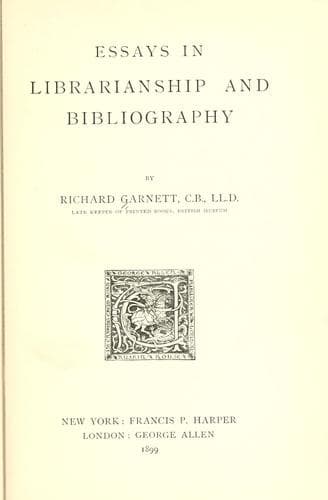
Essays in Librarianship and BibliographyGarnett, Richard
Science
Essays in Librarianship and Bibliography
Garnett, Richard
Bibliography -- Methodology; British Museum; Library science
It is gratifying to remark the augmented consideration, in our day, of
this despised fraternity. There is no omission for which an author of
serious pretensions is now more frequently taken to task than that of an
index; and if on the one hand it is unsatisfactory that the offence
should be so frequent, it is on the other encouraging that its
obnoxiousness should be so generally recognised. "Every author,"
sententiously observes an American sage, "every author should write his
own index. Anybody can write the book." Without going quite to this
length, very many are disposed to affirm of a book without an index what
the Rev. Dr. Folliott, in "Crotchet Castle," affirms of a book without
matter for a quotation, namely, that it is no book at all. Now, what Mr.
Curll's index-maker was to Mr. Curll, librarians are to the general
republic of letters. Every visitor to the Reading Room of the British
Museum who is guided by the mere light of nature persists in styling the
catalogue "the index": their promotion in public consideration has
accordingly kept pace with that of their humbler allies, or rather
exceeded it, for if not starting originally from a point quite so
depressed, they have attained one much more exalted. The cause, however,
is the same in both cases—the enormous increase of knowledge, the need
of a rigorous classification of its accumulated stores, and the
development of a specialised class of workers to discharge this
function. Next to the importance of information existing at all is that
of its being garnered, classified, registered, made promptly available
for use. A good public library has been aptly compared to a substantial
bank, where drafts presented are duly honoured; and librarians, as such,
occupy much the same relation to the republic of letters as the
commissariat to the rest of the army—their business is not to fight
themselves, but to put others into a condition to do it. As a
consequence, their collective organisation is much more complete than of
yore; and their calling assumes more and more the character of a
distinct profession requiring special training, with a distinct tendency
to gravitate towards the Civil Service. Time has been when a
librarianship was most probably a sinecure, or at best a "Semitic
department," created for the express benefit of desert too angular and
abnormal to fit into recognised grooves. Lessing was a typical specimen
of this class of librarian, installed at Wolfenbüttel nominally to
catalogue books but in reality to write them. This type is now nearly
extinct in England, except here and there in one of those colleges which
Mr. Bagehot thought existed to prevent people from over-reading
themselves, or some cathedral, where the functions of librarian are
entrusted to a church dignitary or a church mouse. Elsewhere the
professional character of the librarian's pursuits is pretty generally
recognised; the need of special training and special qualifications is
Public-domain text, read in full here on John Shaqi.
Reviews
Reviews
No reviews yet
Be the first to share your thoughts on this work.
Join the Discussion
Join the discussion
Sign in to leave a comment or review.
Sign InorCreate an account