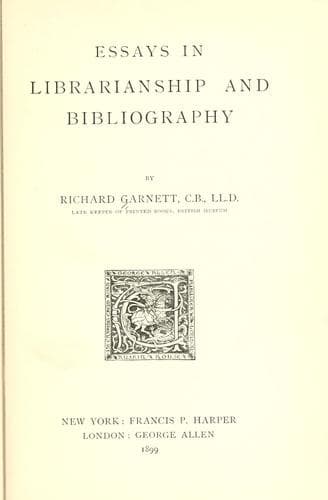
Essays in Librarianship and BibliographyGarnett, Richard
Science
Essays in Librarianship and Bibliography
Garnett, Richard
Bibliography -- Methodology; British Museum; Library science
commonly admitted; and the result has been a general improvement in the
status and consideration of librarians, the more satisfactory as it is
in no degree due to quackery or self-assertion, but has come about by
the mere force of circumstances. It may not be uninteresting briefly to
trace the steps by which librarianship has become a recognised
profession, and the public library an acknowledged branch of the State
service.
"Prior to the year 1835," says Mr. Winter Jones, in his inaugural
address before the first Conference of Librarians, "there had been
little discussion, if any, about public libraries." In that year—the
year of the publication of the epoch-making works of Strauss and De
Tocqueville, and of the removal of Copernicus and Galileo from the
_Index Expurgatorius_—the complaints of a discharged clerk led, _more
Britannico_, to an inquiry into the state of the British Museum, which
would at that time hardly have been granted upon public grounds. From
that inquiry dates everything that has since been done. Some not very
judicious changes in the administrative machinery of the Museum were the
chief ostensible results, but the real service rendered was to create a
consciousness in the public mind of the deficiencies of the national
library—strengthened no doubt by the contemporaneous disclosures of the
condition of the public records. The way was then prepared for the truly
great man who assumed office as Keeper of the Printed Books in 1837, and
whose evidence had mainly created the impression to which we have
referred. To the administration of the British Museum, Sir Anthony
Panizzi brought powers that might have governed an Empire. Sir Rowland
Hill is not more thoroughly identified with the penny post than Sir A.
Panizzi with the improvements which have made the Museum what it is, and
not merely those affected immediately by himself, but those which owe,
or are yet to owe, their existence to the impulse originally
communicated by him. In 1839 the Museum received from Sir A. Panizzi and
his assistants its code of rules for the catalogue—the Magna Charta of
cataloguing. In 1846 the enormous deficiencies of the Library, as
ascertained by prodigious labour on the part of the librarian and his
staff, were fairly brought to the knowledge of the nation. In 1849 Sir
A. Panizzi's multitudinous reforms were tested and sanctioned by one of
the most competent royal commissions that ever sat, whose report offers
at this day a mass of most amusing and instructive reading. We may note
in its minutes of evidence, as subsequently in the yet more remarkable
instance of President Lincoln, how little able Mr. Carlyle is to
recognise his hero when he has got him, and may obtain a new insight
into the extraordinary powers of the late Professor De Morgan. In 1857
Sir A. Panizzi's exertions received their visible consummation in the
erection of the new Reading Room and its appendages, capable of
Public-domain text, read in full here on John Shaqi.
Reviews
Reviews
No reviews yet
Be the first to share your thoughts on this work.
Join the Discussion
Join the discussion
Sign in to leave a comment or review.
Sign InorCreate an account