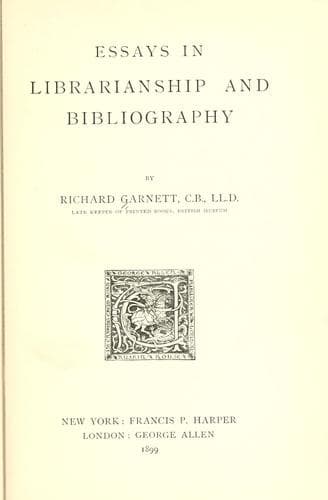
Essays in Librarianship and BibliographyGarnett, Richard
Science
Essays in Librarianship and Bibliography
Garnett, Richard
Bibliography -- Methodology; British Museum; Library science
Due provision having been made for replenishing the library with the
books most appropriate to its circumstances, the question of the
catalogue next presents itself. The controversies which used to prevail
on this point may be regarded as in a great measure laid to rest. The
rules of cataloguing, framed in 1839 by Sir A. Panizzi, Mr. Winter
Jones, and their staff, will, we believe, be now generally accepted by
bibliographers as embodying the principles of sound cataloguing.[43:1]
They may not be equally satisfactory to the general public, with its
preference for rough and ready methods; a very short experience,
however, will convince any man that such methods in cataloguing mean
simply hopeless confusion, and that it is far better that a book should
be now and then hidden away than that entire categories of books should
be entered at random, with no endeavour at principle or uniformity. On
the part of almost all qualified bibliographers, the Museum Catalogue
receives the sincerest form of flattery—imitation: the few points still
debated, such as whether anonymous books with no proper name on the
title-page should be entered under the first substantive or the first
word, are not material; and the impediments sometimes experienced in
consulting it arise from no defect in its cataloguing rules, but from
the great difficulty in digesting such long and complicated articles as
Academies into a perspicuous and logical arrangement. The problem is no
longer one of cataloguing, but of classification, and in this department
ample room remains for discussion and scientific progress. The question
of the strictly classified catalogue _versus_ the strictly
alphabetical, may, indeed, be considered as decided. The former method
may have answered in the library of Alexandria; but the multiplicity of
the departments of knowledge in our own day, their intricacy and the
nicety with which they blend and shade into each other, render
cataloguing solely by subjects a delusion. A catalogue of books on any
special subject must either be imperfect, or must contain a large number
of entries repeated from other catalogues; while, in any case, the
reader can never satisfy himself without a tedious search that the book
he has at first failed to find is not after all actually in the library.
If, nevertheless, a subject catalogue without a general alphabetical
arrangement is often useless, it must be admitted that an alphabetical
catalogue without a subject index is not always useful. It is somewhat
humiliating for the librarian unprovided with this valuable auxiliary,
to find himself dependent upon the classified indexes to the London
publishers' list and Brunet's _Manuel du Libraire_ for information which
he ought to be able to supply from his own catalogue. Even the Bodleian,
we perceive, is about taking measures to prepare an index of subjects,
and the Bodleian is a library for scholars who might not unfairly be
Public-domain text, read in full here on John Shaqi.
Reviews
Reviews
No reviews yet
Be the first to share your thoughts on this work.
Join the Discussion
Join the discussion
Sign in to leave a comment or review.
Sign InorCreate an account