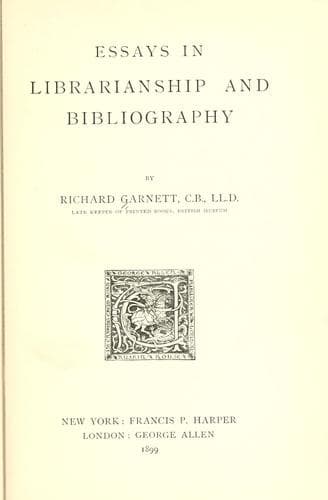
Essays in Librarianship and BibliographyGarnett, Richard
Science
Essays in Librarianship and Bibliography
Garnett, Richard
Bibliography -- Methodology; British Museum; Library science
expected to bring their bibliographical information along with them. The
need must evidently be more imperative in libraries which assume a
distinctly educational function, and in those which, like the national
and most municipal collections, are supported at the expense of the
learned and the ignorant alike. The recognition of the want, however,
imposes an additional strain upon the resources of the institution,
which the British Museum, at all events, over-burdened as it is already,
cannot encounter without a considerable addition to its resources. The
question of classification is, moreover, most difficult of solution.
Only two points seem universally agreed upon: that the best subject
index must be far from perfect, and that the worst is far better than
none. Two principal methods are proposed for adoption. The first is the
simple and obvious one of recataloguing every book entered in the
Alphabetical Catalogue in the briefest possible form, and breaking up
these titles into sections, according to subject, the alphabetical order
being still preserved in each. Thus Simson's "History of the Gipsies"
would be found in the General Catalogue entered at length, and again in
an abridged form in a special index of books relating to the Gipsies,
which would refer the reader to the General Catalogue. The other system
is the so-called Dictionary Catalogue, which combines the main entry and
the subject entry in the same alphabetical series. In such a catalogue
Simson's book would be entered twice over, under Simson and under
Gipsies; while Paspati's "Dictionary of the Dialect of the Turkish
Gipsies," if the librarian were as accommodating as some of his
fraternity, would stand a chance of being catalogued four times over,
under Paspati, Gipsies, Turkey, and Dictionaries. This system, first
brought forward by Mr. Crestadoro, the very able librarian of the
Manchester Free Library, and retouched by Messrs. Jewett, Abbott, and
Noyes, in the United States, has been thoroughly discussed in Mr.
Cutter's masterly contribution to the American report on public
libraries. Mr. Cutter, on the whole, supports the plan, whose defects he
has nevertheless stated with his usual force and candour. The principal
objections are the great bulk of a catalogue constructed upon such a
plan, and the sacrifices of one of the principal advantages of an
alphabetical classed index, the congregation of a great number of minor
subjects into a grand whole. In such an index, for example, works on the
liberty of the subject, Bankruptcy, Divorce, though formed into special
lists, would still be found together within the covers of the same
comprehensive volume on law, and, taken all together, would afford a
general view of whatever existed in print upon that grand division of
human knowledge. In the Dictionary Catalogue, where authors and subjects
are thrown together in the same alphabetical series, this advantage
would be lost; Bankruptcy would be in one part of the catalogue, Divorce
Public-domain text, read in full here on John Shaqi.
Reviews
Reviews
No reviews yet
Be the first to share your thoughts on this work.
Join the Discussion
Join the discussion
Sign in to leave a comment or review.
Sign InorCreate an account