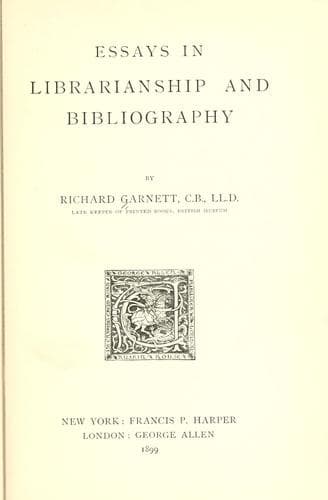
Essays in Librarianship and BibliographyGarnett, Richard
Science
Essays in Librarianship and Bibliography
Garnett, Richard
Bibliography -- Methodology; British Museum; Library science
to the prosaic exigencies of space might in process of time throw it out
of gear altogether. Space is the librarian's capital enemy, and the more
cruel as it turns his own weapons against himself. The more ample the
catalogue, the more liberal the expenditure, the more comprehensive the
classification, the greater, sooner or later, are the difficulties from
lack of space. It is not too early to direct the earnest attention of
the public to the question of the accommodation of the national library.
The pressure upon its capacity, now merely beginning to be felt, will
soon become serious. It cannot from the nature of the case be divided or
dispersed; books required by readers must be within reach of the Reading
Room, or they might as well be nowhere. If the library does not receive
its fair share of the space about to be vacated by the Natural History
departments, the consequence will most assuredly be, first some years of
confusion and deadlock as regards all new acquisitions, and then a large
expenditure, superfluous with better management, upon new buildings,
whose space will be mortgaged before they are completed. It does not
seem to us very difficult to devise means for economising the existing
space to the utmost, and reconciling the interests of all the
departments concerned—but we must not be seduced into a disquisition
upon architecture.[62:1]
Free libraries and public reading-rooms are among the most important
departments of library administration in our day, and constitute the
most distinct expression of the growing conviction that the librarian is
called upon to be a great popular educator. This sentiment has attained
its fullest development in the United States, where the great free
libraries have taken a most important place among national institutions.
Not merely are such cities as Chicago and Cincinnati provided with
libraries of which any city might be proud, but the custodians have in
many instances gone beyond the strict limits of professional duty by not
merely furnishing reading for the people, but instructing the people
what to read. "They have tried," says Mr. Axon in the paper cited
already, "and with no small measure of success, to lead readers to
higher levels of intellectual interest, and to help all students to the
fullest acquaintance with the capabilities of the library." There are no
more remarkable examples of popular bibliography than the various
catalogues and helps published by the Boston Public Library. These
sheets, prepared by Mr. Justin Winsor, have been continued at Harvard
since the indefatigable editor's removal thither as professor of
bibliography. They include lists of the most important books in all
departments of literature, with a selection of the notices of the press
best adapted to explain their purport. Special bibliographies of great
value are frequently interspersed, and when it is considered that the
whole is rather a labour of love than of duty on Professor Winsor's
Public-domain text, read in full here on John Shaqi.
Reviews
Reviews
No reviews yet
Be the first to share your thoughts on this work.
Join the Discussion
Join the discussion
Sign in to leave a comment or review.
Sign InorCreate an account